

5th December 2025
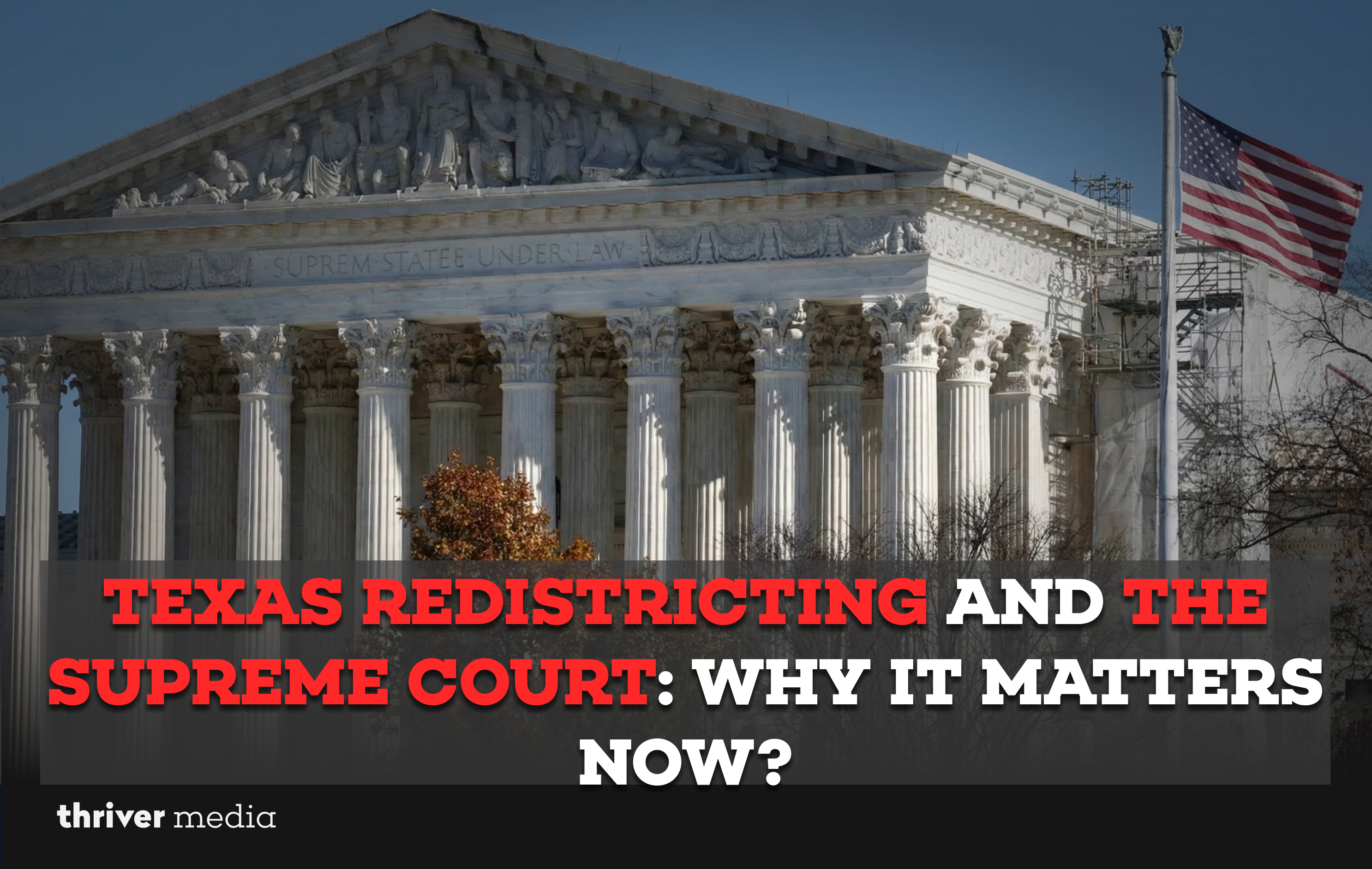
Let’s be honest most headlines about redistricting sound like something out of a law textbook: “Supreme Court Weighs Texas Maps,” “Redistricting Battle Escalates.”
If your eyes glaze over halfway through, you’re not alone.
But here’s the truth: what’s happening with Texas redistricting right now is not some dusty political technicality. It’s a full-scale fight over whose voices matter, who gets political power, and who will shape Texas for the next ten years.
Think of Redistricting Like a Giant Political Puzzle
Every decade, after the Census, Texas redraws the boundaries for its congressional and state legislative districts. Imagine it as political Tetris except the goal isn’t to make clean, perfect lines. The goal is to build a map that helps the party in charge stay in charge.
And at the moment, that’s the Texas GOP. They’re holding the controller.
Texas Isn’t Just Growing It’s Changing
The 2020 Census gave Texas two new congressional seats major political real estate. And here’s the important part: over 95% of Texas’s population growth came from communities of color, especially Latino communities.
Texas isn’t the same state it was twenty years ago. It’s diverse, young, and majority-minority.
But when the new maps came out in 2021, something didn’t line up. Those two new districts? Drawn to favor white-majority, Republican voters. Neighborhoods that share interests were carved apart with lines so strange they practically require GPS to follow.
The end result? Maps that locked in political power but muted the influence of the very communities driving Texas’s growth.
Predictably, lawsuits followed. Courtrooms filled. And eventually, everything made its way to the Supreme Court.
What Is the Supreme Court Actually Deciding?
The Court isn’t choosing sides on fairness or political vibes. Their job is much narrower, and unfortunately, much tougher for challengers.
They’re weighing two key questions:
1. Did Lawmakers Use Race Improperly?
Under the 14th Amendment and the Voting Rights Act, states can’t use race as the main factor when drawing districts if the goal is to weaken a racial group’s political voice.
But here’s the problem:
The Supreme Court has made it extremely hard to prove racial intent.
You practically need a signed confession.
2. Or Was It Just Politics?
And this is the loophole lawmakers rely on.
In 2019, the Court ruled that federal courts can’t intervene in partisan gerrymandering. So if lawmakers say, “We drew this district because it helps our party not because of anyone’s race,” that usually ends the argument.
It’s the perfect legal escape hatch.
Straightforward Answers to the Big Questions
Not entirely. Racial discrimination in map-drawing is still illegal. But since it’s so hard to prove, and partisan gerrymandering is off-limits to federal judges, mapmakers have more freedom than ever.
It’s less about whether a map feels unfair and more about whether anyone can definitively prove why it was drawn that way.
Your political power may shrink without you realizing it.
You could end up in a district so tilted that your vote barely dents the outcome. That means representatives don’t need to work for your support or care about your community’s needs to stay in office.
It influences everything schools, healthcare, infrastructure, and who speaks for you in Washington and Austin.
Yes, but the battleground is shifting.
State courts are now becoming major players under state constitutions.
Independent redistricting commissions are gaining ground in other states.
And demographics continue to evolve fast. Growth patterns could eventually outpace even the most carefully designed gerrymanders.
Groups like the Texas Civil Rights Project and MALDEF are pushing this fight daily.
The Larger Story: Power, Not Paperwork
This isn’t a dry legal dispute it’s a power struggle. And the Supreme Court’s recent decisions signal something loud and clear:
They’re putting the responsibility back on state lawmakers and treating them as if they act in good faith.
The burden to challenge maps now falls heavily on voters and advocacy groups, who must gather near-impossible evidence to win.
Conclusion: Who Gets to Draw the Future of Texas?
Texas stands at a turning point. We’re living in one of the fastest-growing, most diverse states in the country but political maps haven’t kept up.
The Supreme Court is betting that voters will eventually correct the system. But when the people who draw the maps are also the ones benefitting from them, change doesn’t come easily.
The real fight isn’t only in courtrooms. It’s happening in community meetings, public hearings, elections, demographic shifts, and in the demands of Texans who want a government that reflects the people it serves.
Drawing the lines shouldn’t be a privilege reserved for politicians.
It should be a process shaped, however imperfectly, by the people who live within those lines.
Disclaimer: The news and information presented on our platform, Thriver Media, are curated from verified and authentic sources, including major news agencies and official channels.
Want more? Subscribe to Thriver Media and never miss a beat.