

22nd January 2026
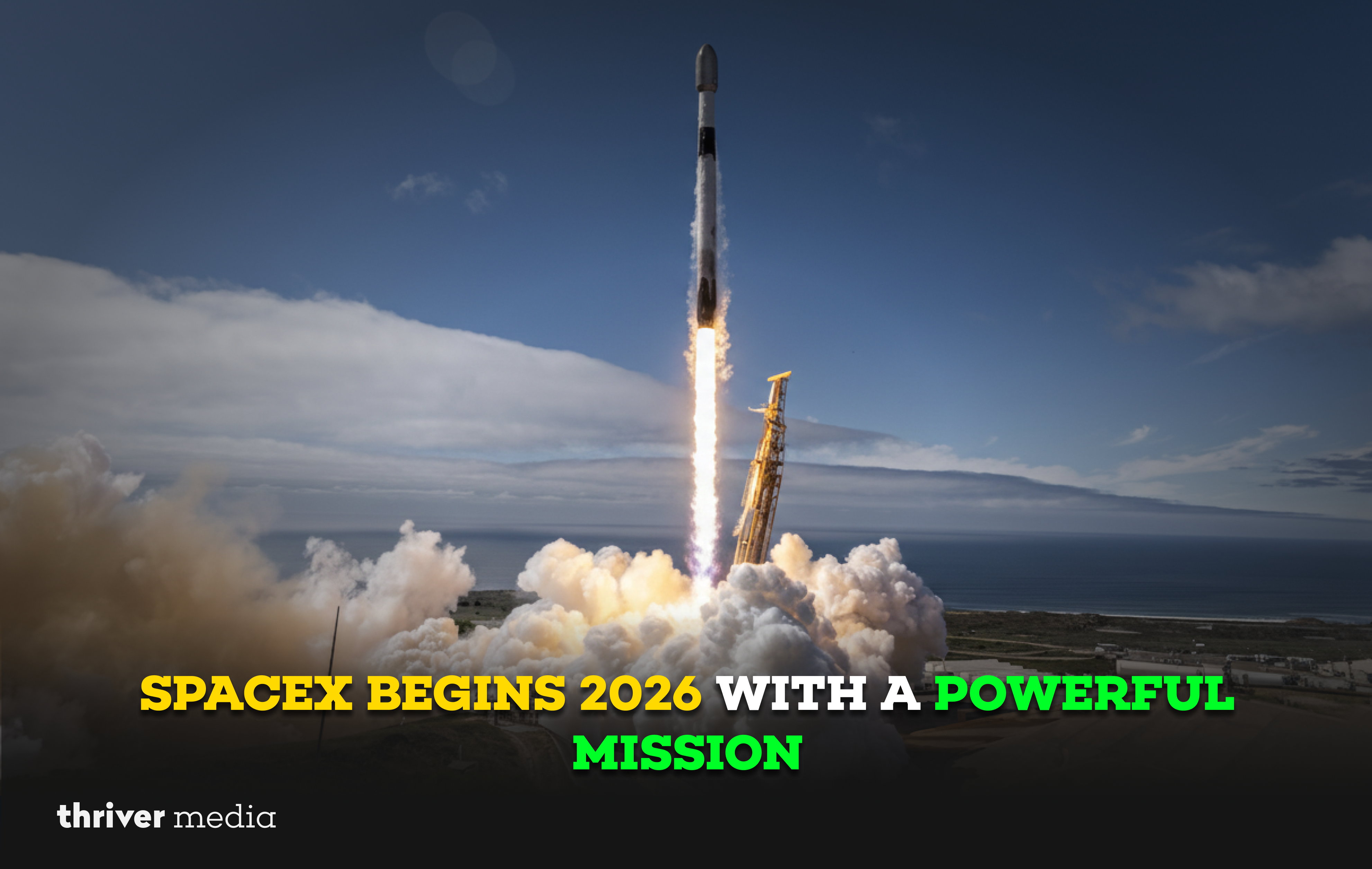
A streak of orange fire pierced the pre-dawn darkness over Florida’s coast. The rumble of nine Merlin engines rolled across the marshland, announcing not just a new launch, but a new year in spaceflight. As the Falcon 9 rocket ascended, its trajectory arcing gracefully over the Atlantic, it carried more than satellites it carried the opening statement of 2026’s strategic space agenda.
This wasn’t a mission to resupply the International Space Station or to add to a mega-constellation of internet satellites. The mission carried a tightly guarded payload to a classified orbit, directly supporting U.S. national security operations. The successful launch on January X, 2026, marks a powerful and deliberate start to the year, underscoring the deepening fusion of private space capability and government defense strategy.
In the quiet that followed the booster’s return to a droneship landing, the significance of the moment settled. SpaceX has once again demonstrated its role as a foundational partner in American space access, beginning the calendar with a mission that reinforces surveillance, intelligence, and deterrence in an increasingly contested domain.
Key Takeaways
- SpaceX successfully conducted the first U.S. national security space launch of 2026.
- The mission deployed advanced spy satellites into orbit for intelligence-gathering operations.
- It highlights the ongoing strengthening of U.S. space-based defense and surveillance capabilities.
- The launch cements SpaceX’s central, trusted role in critical government missions.
- This event has tangible implications for global space security strategy and competition.
Table of Contents
Mission Overview: A Classified Ascent
Although officials keep specific details under tight security, the mission’s broad outline follows a familiar yet still significant pattern. A flight-proven SpaceX Falcon 9 rocket lifted off from Space Launch Complex 40 at Cape Canaveral Space Force Station in Florida. National security missions often use early-morning launch windows to meet specific orbital requirements.
The payload, designated simply as “USSF-XXX” by the U.S. Space Force, is a collection of next-generation surveillance satellites. These are not the monolithic, school-bus-sized keyhole satellites of old, but are likely part of a more resilient, modular architecture. These satellites collect vital intelligence data, including high-resolution imagery, signals intelligence, and other reconnaissance that informs national decision-making.
The “why” behind the secrecy is straightforward: operational security. Revealing exact capabilities, orbital parameters, or mission profiles would allow potential adversaries to evade surveillance or develop countermeasures. The success confirmation”payload deployed” is often the only public milestone provided.
Why This Mission Matters
This launch is far more than a routine satellite delivery. It represents a critical refresh and augmentation of America’s “eyes and ears” in space. In a world where geopolitical tensions can flare with little warning, persistent, timely intelligence is a non-negotiable element of national security and diplomatic leverage.
These satellites form the backbone of space-based surveillance, capable of monitoring troop movements, tracking missile launches, verifying arms control treaties, and providing crucial data during international crises. They help ensure stability by reducing uncertainty and deterring aggression through transparency.
Furthermore, the mission underscores a seismic shift in how the government accesses space. SpaceX is no longer just an alternative provider; it is becoming the default workhorse. The reliability and frequency with which SpaceX executes these missions allows the U.S. to modernize its space architecture at a pace that was unimaginable in the era of costly, expendable, government-only rockets.
SpaceX’s Growing Role in Government & Defense
SpaceX’s journey from a risky startup to a pillar of national security launch is a story of demonstrated performance. With this mission, the company adds another successful National Security Space Launch (NSSL) to a long list that includes missions for the Space Force, the National Reconnaissance Office (NRO), and NASA.
The catalyst for this dominance is the Falcon 9’s reusability. By routinely recovering and reflying first-stage boosters, SpaceX has dramatically driven down the cost of access to space. This economic reality has empowered the Pentagon to launch more frequently, deploy more resilient satellite constellations, and accelerate innovation without being paralyzed by budget-busting launch prices.
This cost efficiency, coupled with an unmatched launch tempo and a near-perfect recent success record, has built immense trust with U.S. agencies. The relationship has evolved from a contractual partnership to a foundational dependency, with SpaceX’s launch manifest now intricately woven into the fabric of U.S. defense and intelligence strategy.
Global Impact: A Statement in the High Frontier
The launch does not occur in a vacuum. It is a move observed and analyzed by space capitals around the world, from Beijing and Moscow to New Delhi and Paris. It reinforces two clear trends in the global space landscape.
First, the intensification of great power competition in space. As China and Russia advance their own sophisticated reconnaissance and counter-space capabilities, the U.S. is compelled to continuously advance its own. This mission is a direct response to that environment, an effort to maintain a qualitative and quantitative edge in space-based intelligence.
Second, it highlights the growing militarization of space. While the satellites themselves are likely for surveillance a passive, albeit powerful, activity they are part of a broader ecosystem that includes ground-based anti-satellite weapons, electronic jammers, and orbital threat vehicles. This launch contributes to a strategic balance where space is no longer a sanctuary but a potential front line, making the resilience and redundancy of assets paramount.
Major Drawbacks or Concerns
The growing capability and dependency illustrated by this mission are not without significant concerns.
- The Secrecy Dilemma: While necessary for security, the extreme classification surrounding these missions fuels public speculation and can stoke international distrust. It complicates public discourse on arms control and the norms of behavior in space.
- The Debris Factor: Every launch adds to the orbital population. Although the Falcon 9’s upper stage is designed to responsibly deorbit when possible, the long-term sustainability of the space environment remains a pressing challenge that all operators, including for national security, must address.
- Corporate Dependence: The U.S. government’s reliance on a single private company for such critical access creates a strategic concentration risk. While healthy competition is developing, the current landscape makes the nation’s space logistics uniquely tied to the health and operational continuity of SpaceX.
- An Accelerating Arms Race: Each advancement in surveillance or defensive capability can be perceived as a threat by rivals, potentially spurring cycles of escalation and investment in disruptive technologies that make space less safe for all.
Mission Snapshot: At a Glance
Every national security launch carries layers of secrecy, but the confirmed mission details still paint a clear picture of what took place. Below is a quick overview of the launch essentials, based on officially released information. Specific payload and orbital data remain classified, which is standard practice for intelligence-related missions.
| Aspect | Details |
| Mission Type | National Security / Intelligence |
| Launch Vehicle | Falcon 9 (Flight-Proven Booster) |
| Payload | Classified US Spy / Surveillance Satellites |
| Launch Site | Cape Canaveral Space Force Station, Florida |
| Mission Goal | Orbital deployment for intelligence operations |
| Year | 2026 |
| Operator | U.S. Space Force / SpaceX |
Note: Specific payload identity and orbital parameters are officially classified for security reasons.
Frequently Asked Questions (FAQ)
It’s a broad term for satellites used for defense and intelligence purposes. This can include spacecraft that take high-resolution images, intercept communications, monitor missile launches, or provide secure communications for military forces.
SpaceX offers a combination of high reliability, frequent launch availability, and significantly lower cost primarily due to rocket reusability. This allows the government to deploy and update its space assets more quickly and affordably than was possible before.
Very few. The launch time, rocket type, and general purpose (e.g., “national security”) are typically announced. Almost all details about the satellites’ capabilities, exact orbit, and specific mission are classified.
It reinforces an existing trend. While surveillance itself is not an offensive act, it is a core military capability in a domain that is increasingly viewed as contested. The launch is part of a broader pattern where major powers are deploying more dual-use and military-specific assets into orbit.
Absolutely. This launch is just the first of several planned National Security Space Launches for the year. The pace of such missions is expected to remain high as the U.S. continues to build out its next-generation space architecture.
The Bottom Line
This launch signals that 2026 will be a year of continued assertive action in space. The priority is clear: leveraging the efficiency and innovation of the commercial sector to rapidly deploy capabilities that ensure strategic advantage and national security from orbit.
Conclusion
As the sun rose on the Florida coast after the launch, the contrail had long since dissipated. But the statement was made. SpaceX’s first launch of 2026 powerfully symbolizes the current era: one where American national security is inextricably linked to commercial rocketry, and where the quiet work of satellites overhead plays an outsized role in the balance of power on Earth.
The year in space has begun not with a whisper, but with the confident roar of a Falcon 9. It sets the stage for a year where we will watch not only for the next breathtaking launch but for the subtle shifts in global strategy that these missions enable. The powerful mission is complete, but its implications for intelligence, defense, and international relations are just beginning to unfold.
Disclaimer: The news and information presented on our platform, Thriver Media, are curated from verified and authentic sources, including major news agencies and official channels.
Want more? Subscribe to Thriver Media and never miss a beat.