
3rd February 2026
Key Points of AI Marketing:
- From Crystal Ball Guessing to Data-Backed Predicting: We traded gut feelings for algorithms that spot trends before they’re trends.
- From “Spray and Pray” to “Sniper-Level Precision”: We moved from blasting generic messages to millions, to whispering the right offer to one person at the exact right moment.
- From Quarterly Reports to Real-Time Dashboards: We swapped out slow, backward-looking reports for live feeds showing what’s working right now.
- From Manual Everything to Strategic Oversight: Marketers have been promoted from doing repetitive tasks to orchestrating intelligent systems.
The Problem: The Slow, Reactive, and Inefficient Past
For decades, marketing was hampered by three core issues: lagging data, manual execution, and one-size-fits-all communication. This created a reactive cycle that stifled growth and innovation.
The “Blindfolded Decisions” of the Past
Back then, marketing decisions were primarily based on historical data; however, this data was often months old, making timely action difficult. Campaign performance was analyzed after it ended, making course correction a slow, costly process. Demographics were king; you targeted “women 25-40” with no insight into individual intent or behavior. This led to massive budget waste and missed opportunities.
The Human Impact: Marketers spent countless hours on manual tasks: building spreadsheets, parsing basic analytics, and executing repetitive A/B tests. Creativity was stifled by operational grind.
The Solution: The Rise of Predictive, Real-Time Intelligence
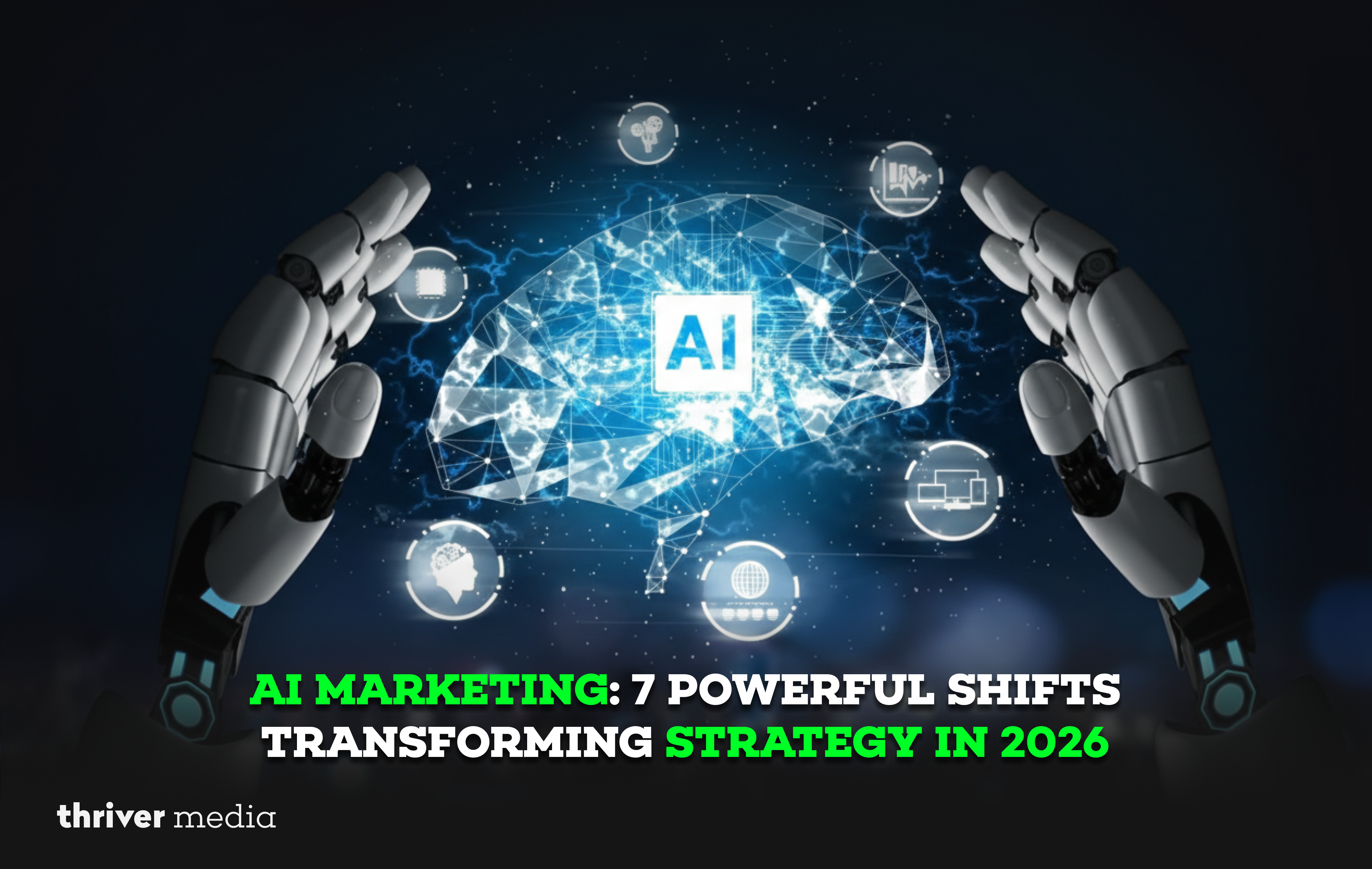
In AI Marketing 2026, AI analyzes live data streams website behavior, social interactions, and purchase history to predict what a customer will do next. Instead of relying on past reports, AI Marketing 2026 systems process real-time signals to guide smarter decisions instantly.
Tools like predictive analytics platforms and customer data platforms (CDPs) synthesize billions of data points to score leads, forecast churn, and recommend next-best actions in real time. This is what separates traditional automation from true AI Marketing 2026 strategy.
The marketer’s role shifts from data reporter to strategic forecaster interpreting insights, setting direction, and refining systems that power AI Marketing 2026 at scale.
A Direct Comparison: The Marketing Funnel Then vs. Now
| Marketing Stage | The Past (2010s Era) | The Present (AI-Powered Era) | What Changed |
| Awareness | Broad TV/radio ads, print media, generic SEO blog posts. | Hyper-targeted social/programmatic ads, intent-based SEO, AI-generated content tailored to search intent. | From mass broadcast to micro-conversation. |
| Consideration | Static email blasts, one-size-fits-all landing pages, sales calls with little prospect context. | Dynamic email journeys, AI-personalized website experiences, chatbots providing instant, informed answers. | From generic to genuinely helpful. |
| Conversion | Manual lead scoring, slow follow-ups, intuition-based closing. | AI-powered lead scoring & routing, automated follow-up sequences, predictive prompts for sales teams. | From hoping to knowing who’s ready to buy. |
| Loyalty | Occasional email newsletters, loyalty punch cards, generic surveys. | Predictive replenishment alerts, hyper-personalized rewards, AI-driven “win-back” campaigns for at-risk customers. | From transactional to relational. |
The Creativity Crunch vs. The Creative Catalyst
Then: Creativity was often limited by production bottlenecks. A/B testing a single ad variation could take weeks. Personalization meant mail-merging a first name into an email.
Now: Generative AI tools like Jasper or DALL-E allow for the rapid creation of hundreds of ad variants, subject lines, or visual concepts in minutes. AI handles the production heavy lifting, freeing human creatives to develop higher-level strategy and narrative. This solves the problem of scale, allowing for true multivariate testing and dynamic creative optimization (DCO) that was previously a logistical nightmare.
Your Questions Answered
Yes, but it was descriptive data (telling you what already happened). AI introduces predictive and prescriptive data telling you what will happen and what you should do about it. It’s the difference between a weather report and a climate-controlled room.
Absolutely not. Companies have raised its status. The present allows humans to focus on strategy, empathy, and brand story. AI handles the “what” and “when,” humans master the “why” and “how it feels.“
The foundational shift began with big data in the early 2010s, but the explosion of accessible, cloud-based AI tools (ca. 2018-present) has accelerated it from a Fortune-500 luxury to a mainstream necessity in just a few years.
Industry reports from leading analysts track this evolution.
Official Source: McKinsey & Company’s “The state of AI in 2023” shows the acceleration of adoption across functions, including marketing. McKinsey AI Report
The Bottom Line:
In the past, companies often viewed marketing as a cost center, treating it as a necessary expense with unclear ROI. Today, AI-powered marketing is a measurable growth engine. The shift from lagging to leading indicators means marketing can prove its impact on revenue in real-time and directly attribute sales to specific, AI-optimized campaigns
Conclusion: Looking Back to Move Forward
The comparison between past and present marketing is stark: we’ve moved from guessing to knowing, from generic to personal, from slow to instantaneous. AI hasn’t just added new tools to the old toolbox; it has built an entirely new workshop. It solved the fundamental problems of inefficiency and irrelevance that plagued marketers for generations.
As we move toward 2026 and beyond, the tools will evolve from being assistive to being collaborative and autonomous. We’ll see the rise of AI marketing “agents” that manage entire campaign ecosystems, make strategic budget allocations, and generate fully integrated cross-channel content all under human guidance. The marketer of the future won’t just use AI; they will orchestrate a symphony of intelligent systems to build brands that don’t just respond to culture, but proactively shape it. The lesson from the past is clear: the businesses that thrive will be those that embrace this continuous transformation, using the intelligence of the present to anticipate the needs of the future.
Want more? Subscribe to Thriver Media and never miss a beat.