

23rd February 2026
Every few months, a new video surfaces. Armored vehicles painted in camouflage. Men in tactical gear carrying rifles they aren’t legally permitted to possess. Burning trucks blocking highways. The imagery is unmistakable it looks like a war zone.
Headlines call it “cartel wars.” Politicians speak of “fighting enemies within.” Tourists cancel trips. And a question hangs in the air that deserves more than a reflexive answer:
Is Mexico actually in a war or are we using that word too loosely?
The answer mattersIt shapes how travelers assess risk. Journalists rely on it when choosing their language. Policymakers depend on it when crafting responses. And it matters for the 130 million people who call Mexico home, many of whom live nowhere near the violence that dominates international coverage.
This article breaks down seven facts that separate perception from reality, examines what “war” actually means under international law, and gives you the context to understand Mexico’s security situation without the drama, and without the dismissal.
Before We Begin: What Does “War” Actually Mean?
Words lose their edges when we use them constantly. “War” is one such word.
Under international law, particularly the Geneva Conventions, a war exists when:
- There is a declared state of armed conflict between nations, or
- There is protracted armed violence between governmental authorities and organized armed groups, or between such groups within a state
- The key distinction lies in intensity and organization. Sporadic violence, even deadly violence, doesn’t constitute war. Neither does criminal activity, however brutal.
Mexico sits in a gray zone. The violence in some regions meets certain criteria organized groups, military-grade weapons, territorial control. But it lacks others: there’s no declared war, no suspension of constitutional governance, and crucially, no political objective from the armed groups.
This isn’t semantics. The distinction affects everything from how other nations respond to whether insurance claims are valid to how we understand what’s actually happening.
Fact 1: Mexico Is Not Officially at War
Let’s start with what’s legally verifiable: Mexico has not declared war on anyone.
Article 89 of Mexico’s Constitution explicitly requires congressional approval for any declaration of war. That hasn’t happened. Not in 2006 when Felipe Calderón deployed the military against cartels. Not in any year since.
What exists instead is a series of governmental policies variously called the “war on drugs,” “security operations,” or “confronting organized crime” that have militarized public security. But policy is not war.
This matters because declaring war triggers specific international legal frameworks. Prisoners of war, for instance, have different protections than criminal detainees. Military engagements follow different rules of engagement than law enforcement operations. Mexico operates in the latter category, however blurred the lines have become.
The absence of a declared war also means Mexico’s civilian government continues functioning. Elections happen. Courts rule. Schools operate. The machinery of state hasn’t been suspended, even in regions where the state’s presence is contested.
So when you hear “Mexico is at war,” the accurate response is: not legally, no.
Fact 2: Cartels Control Territory But Not Like a Government Would
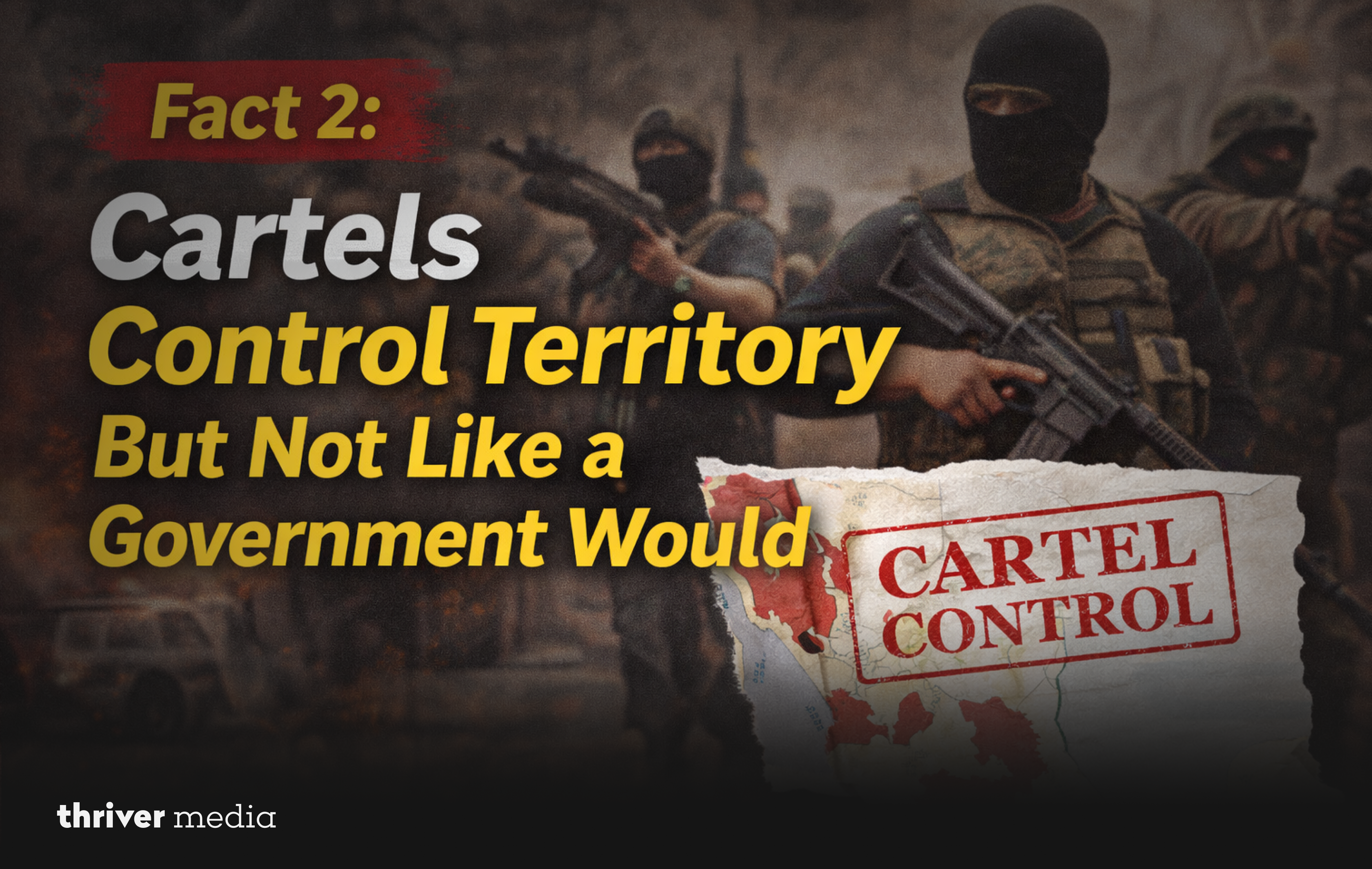
Here’s where the war analogy gains traction. In parts of Michoacán, Guerrero, and Tamaulipas, cartels do control territory. Cartel members man checkpoints across certain routes.
Local businesses are often forced to pay so-called “taxes” to operate.
In many areas, their rules carry more weight than official law.
This looks like insurgency. But look closer.
Cartel territorial control differs fundamentally from that of a rebel army. Rebel groups typically seek to displace the government they want to become the state. Cartels want to coexist with the state, penetrating and corrupting it rather than replacing it.
Criminal organizations need functioning governments to process licit economic activity, maintain roads for transport, and provide services that keep populations compliant. They don’t want to run schools or hospitals. They want protection for their illicit enterprises.
This distinction explains why cartel violence flares and recedes based on business competition, not political timelines. When two groups fight over a plaza, it’s a market dispute, not an ideological battle. The violence can be horrific. But it’s not war in the conventional sense.
Fact 3: The Military Is Actively Deployed in Civilian Roles
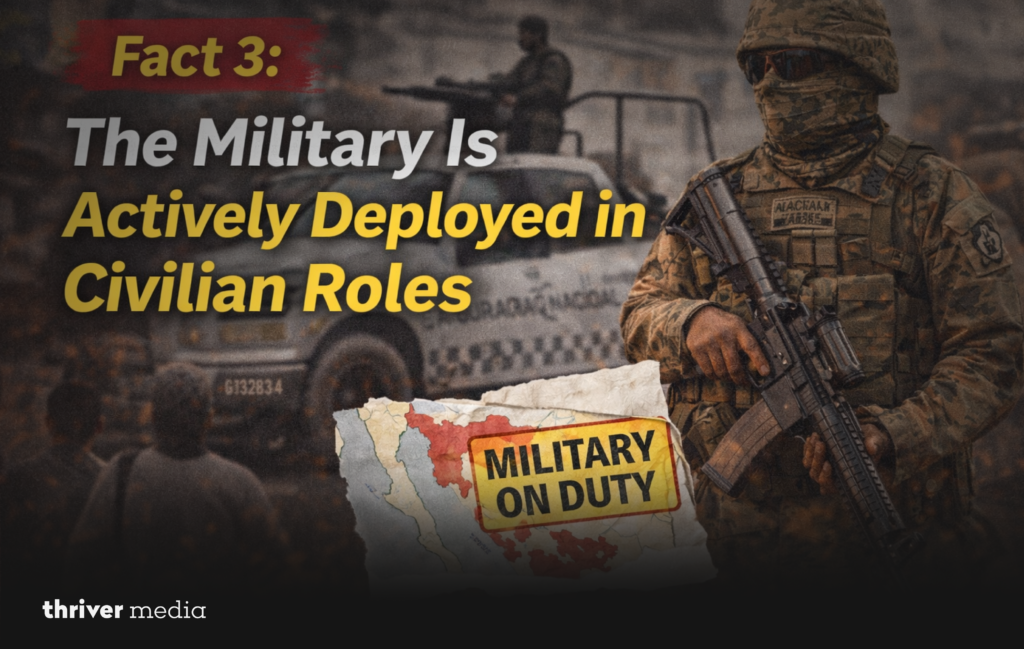
Approximately 350,000 military personnel currently perform public security functions in Mexico. If you visit certain parts of the country, you’ll see soldiers on street corners, at airports, conducting vehicle inspections.
This is unusual. Most democracies keep military forces separate from domestic policing a concept called the posse comitatus principle. Mexico, facing police forces overwhelmed and corrupted, made a different choice.
The militarization of public security creates war-like optics. When you see young soldiers with rifles in tourist zones, it’s reasonable to wonder if something is wrong. Something is. But the presence of soldiers doesn’t itself constitute war it constitutes a policy choice about how to address criminal violence.
Notably, this policy is deeply controversial within Mexico. Human rights organizations document abuses by military personnel. Constitutional scholars question its legality. Multiple Supreme Court rulings have attempted to limit military involvement in civilian law enforcement. Yet the policy persists because alternatives remain weak.
Fact 4: Violence Is Highly Regional Not Nationwide
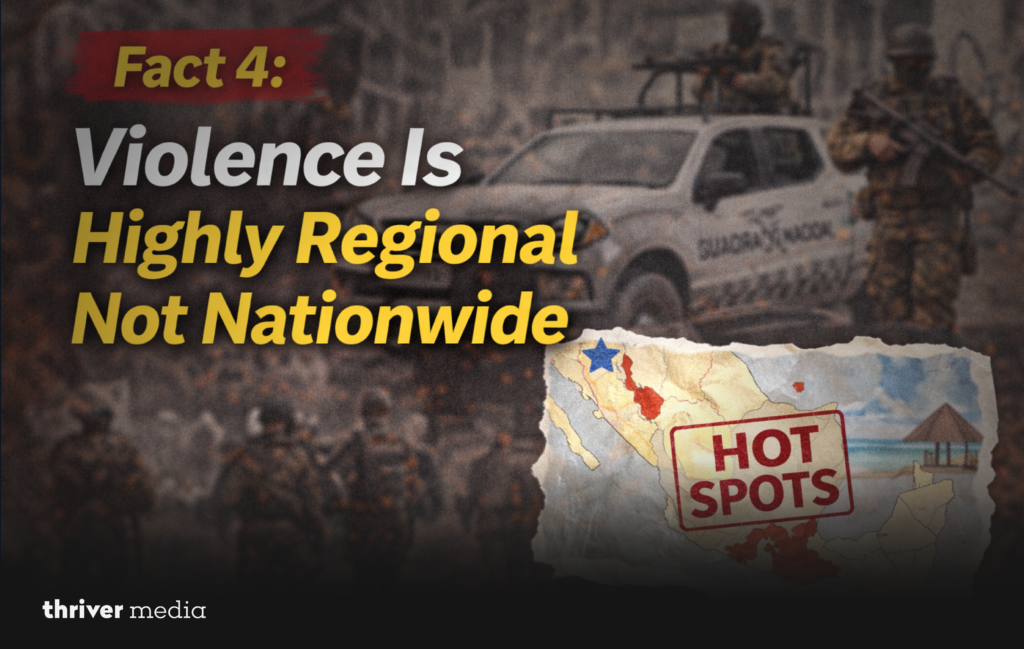
This is perhaps the most important fact for understanding Mexico: violence concentrates in specific zones, leaving vast areas functioning normally.
Consider these contrasts:
- Guanajuato consistently records the highest homicide numbers over 3,000 in 2023 alone. Cartel competition for fuel theft and local markets drives this.
- Michoacán sees persistent violence between the Jalisco New Generation Cartel and local groups.
- Zacatecas has become a battleground for territorial control.
Meanwhile:
- Yucatán maintains a homicide rate comparable to rural Norway around 2 per 100,000 residents.
- Campeche, Tlaxcala, and Baja California Sur all record rates below the US national average.
- Tourist zones present a mixed picture: Cancún and Los Cabos have seen violence, but it overwhelmingly occurs away from tourist areas and involves cartel members, not visitors.
This regional variation means blanket statements about Mexico being “dangerous” or “at war” mislead more than inform. The question isn’t whether Mexico is safe it’s whether specific areas at specific times present risks.
Fact 5: Homicide Rates Have Reached Historic Highs
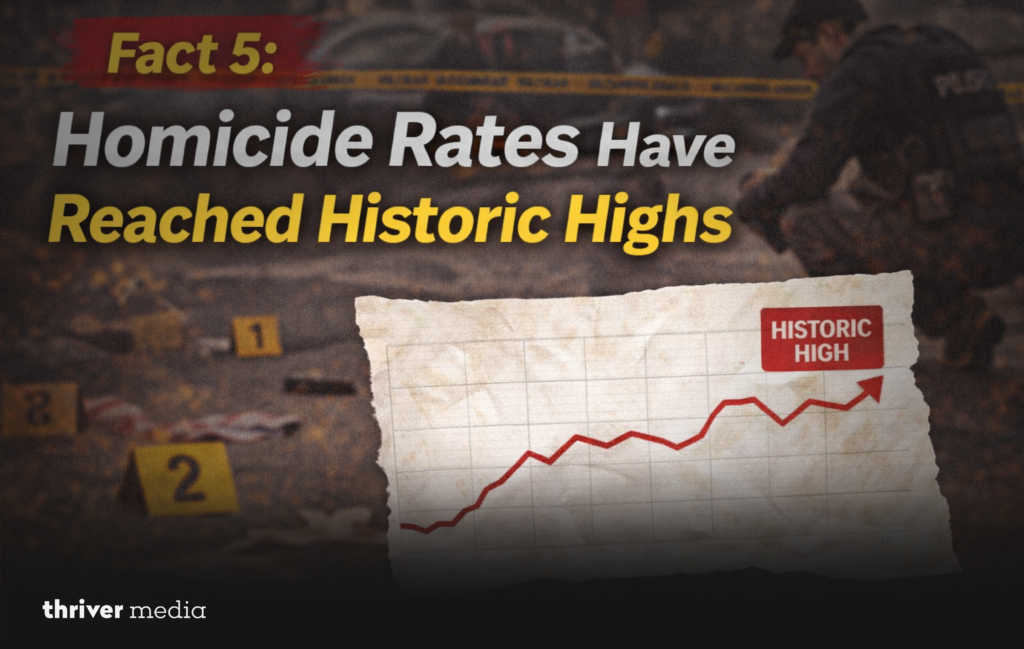
The data doesn’t lie about scale. Mexico recorded approximately 30,000 homicides in 2023. The rate hovers around 23 per 100,000 residents roughly three times the US average.
To understand what this means, context helps:
| Location | Homicide Rate (per 100,000) |
| Mexico (national average) | ~23 |
| United States (national average) | ~6.5 |
| Active conflict zones (Syria, Yemen) | 40–70+ |
| European averages | 1–2 |
| Mexico’s safest states | 2–5 |
The peak years of 2019-2021 saw the highest rates since modern record-keeping began in the 1990s. Some reduction has occurred since, but levels remain elevated.
However, homicide rates alone don’t indicate war. Several US cities have rates exceeding 50 per 100,000 higher than Mexico’s national average yet no one suggests the US is at war. The difference lies in the nature of violence, not merely its frequency.
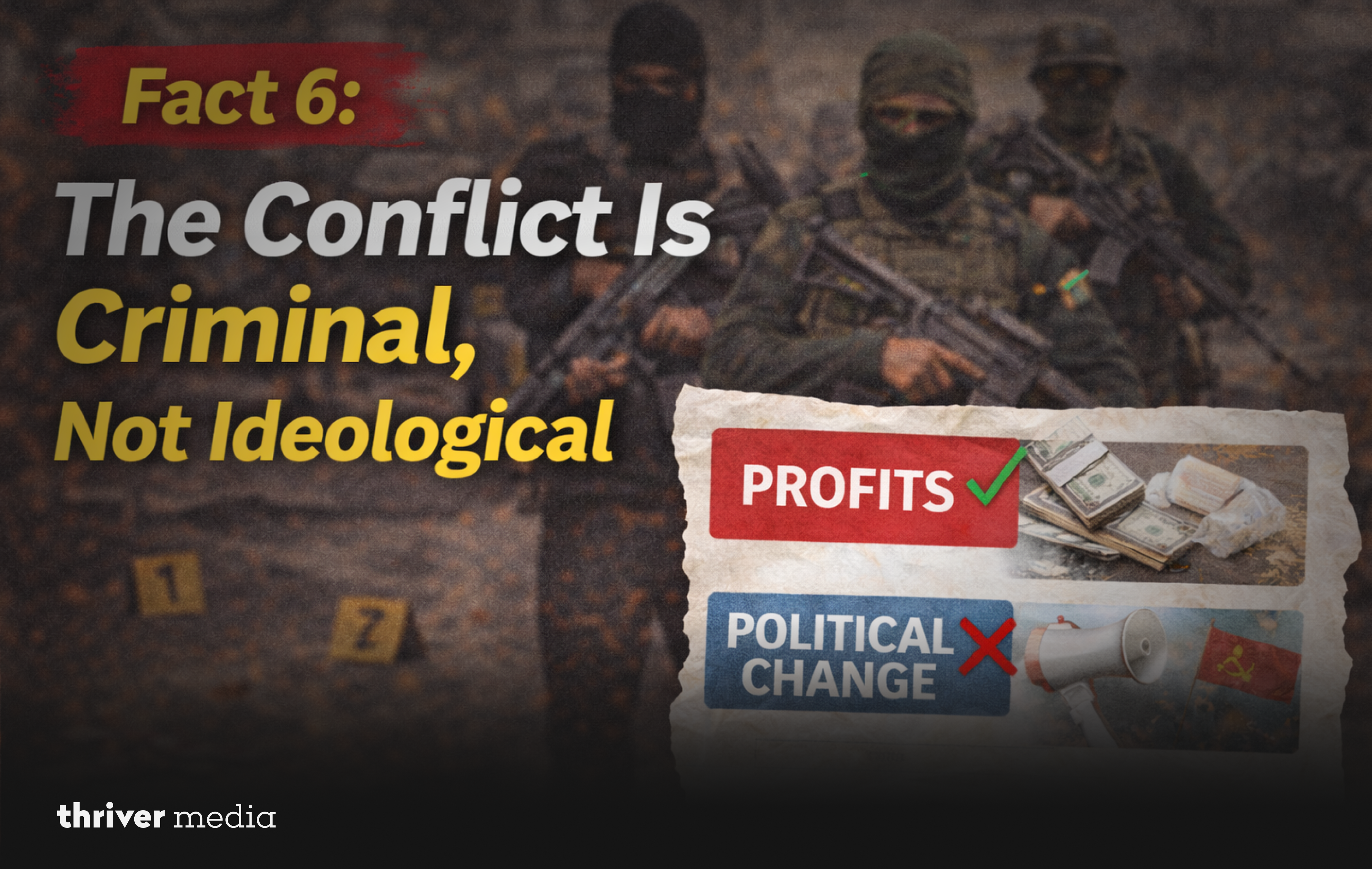
Fact 6: The Conflict Is Criminal, Not Ideological
This distinction matters enormously.
Rebel armies in Colombia’s decades-long conflict sought political transformation. The FARC operated as a Marxist-Leninist army with clear political objectives. They controlled territory and provided governance because they wanted to build a new state.
Mexican cartels seek nothing of the sort.
Cartels are profit-maximizing enterprises. They diversify into legitimate businesses, invest in real estate, and cultivate political connections not to transform society, but to protect their illicit revenue streams. Violence is a tool, not an objective. It escalates when competition demands it and recedes when arrangements stabilize.
This explains patterns that confuse outside observers: why cartels sometimes cooperate with each other, why violence can suddenly drop in previously bloody regions, why negotiations occasionally succeed despite “war” rhetoric.
Criminal violence responds to market incentives. War responds to political objectives. Mexico’s violence follows the former logic.
Fact 7: Media Language Shapes What We Think We See
The final fact concerns us the consumers of news about Mexico.
Headlines compete for attention. “Three Killed in Dispute Between Criminal Groups” generates fewer clicks than “Cartel Massacre Shocks Region.” The incentives push language toward the dramatic.
Social media amplifies this. Videos of burning vehicles circulate globally. Images of armed men in tactical gear become shorthand for an entire country. The rare becomes representative.
Mexicans themselves often express frustration with how their country is portrayed. When I asked a Mexico City resident about the “war” framing, his response was telling: “I read about it online. Then I walk to the corner store for bread and nothing happens. Which is real?”
Both are real. The violence is real for those experiencing it. The normalcy is real for millions who don’t. Media tends to show only one side.
Has Mexico Been in War? A Brief History
Mexico has known actual war, and the memory shapes how Mexicans use the word.
- The Mexican Revolution (1910-1920) killed approximately 500,000 people nearly 3% of the population. Armies marched across the country. Presidential palaces changed hands. Entire social structures transformed. When Mexicans hear “war,” this is the historical reference point.
- The Cristero War (1926-1929) pitted Catholic rebels against the secularizing government, claiming 90,000 lives in a religious conflict often overlooked outside Mexico.
- Mexico participated in World War II on the Allied side, sending an air force squadron (the famous Aztec Eagles) and contributing resources, though not ground troops.
- The Mexican-American War (1846-1848) remains deeply relevant to US-Mexico relations. The Treaty of Guadalupe Hidalgo ended that conflict, ceding California, Arizona, New Mexico, and other territories to the United States. For Mexican audiences, questions about “war with the US” carry historical weight Americans may not fully appreciate.
These historical wars share characteristics absent today: declared hostilities, political objectives, mass mobilization. Today’s violence differs in kind, not just degree.
Practical Questions: What This Means for You
Is There Currently a War in Mexico?
No Mexico has no declared war; it faces serious, region-specific criminal violence, but calling it a “war” oversimplifies the reality.
Is It Safe to Go to Mexico Right Now?
Safety depends on the region, but millions visit tourist areas each year without incident by following basic travel precautions.
When Was the Last War with the United States?
The Mexican–American War ended in 1848, and the two countries have been formal partners and major trading allies ever since.
Bottom Line: Why Language Matters
Mexico faces a serious security challenge. Organized criminal groups have corrupted institutions, terrorized communities, and accumulated power that challenges the state in specific regions. Thousands of lives are lost annually. The situation demands attention, resources, and solutions.
But calling this a “war” misleads in critical ways:
- It implies a clarity of sides that doesn’t exist civilians are caught between criminal groups and security forces, often victimized by both.
- It suggests an endpoint wars end with treaties or surrenders while criminal violence evolves with markets.
- It grants legitimacy to criminal groups, framing them as armies rather than what they are: sophisticated criminal enterprises.
The better question isn’t whether Mexico is at war. The better question is how nations address organized criminal violence that has become so powerful it mimics war without formally being one.
Conclusion: Reframing the Question
Perhaps Mexico’s situation reveals something about our concepts themselves. We developed our vocabulary of conflict in an era of nation-states fighting nation-states, of armies in uniform, of political objectives clearly stated.
Criminal violence that controls territory, deploys military-grade weapons, and corrupts institutions doesn’t fit neatly into that framework. It’s not war. But it’s not peace either.
The challenge for journalists, policymakers, and citizens trying to understand is to describe accurately without sensationalizing. To acknowledge severity without mislabeling. To see the violence in Michoacán and the normalcy in Mérida as both part of the same country.
Mexico isn’t at war. But it is facing something that defies easy categorization. And sometimes, the most honest answer to “Is Mexico in a war situation?” is this:
It’s more complicated than that question allows.
Disclaimer: The news and information presented on our platform, Thriver Media, are curated from verified and authentic sources, including major news agencies and official channels.
Want more? Subscribe to Thriver Media and never miss a beat.