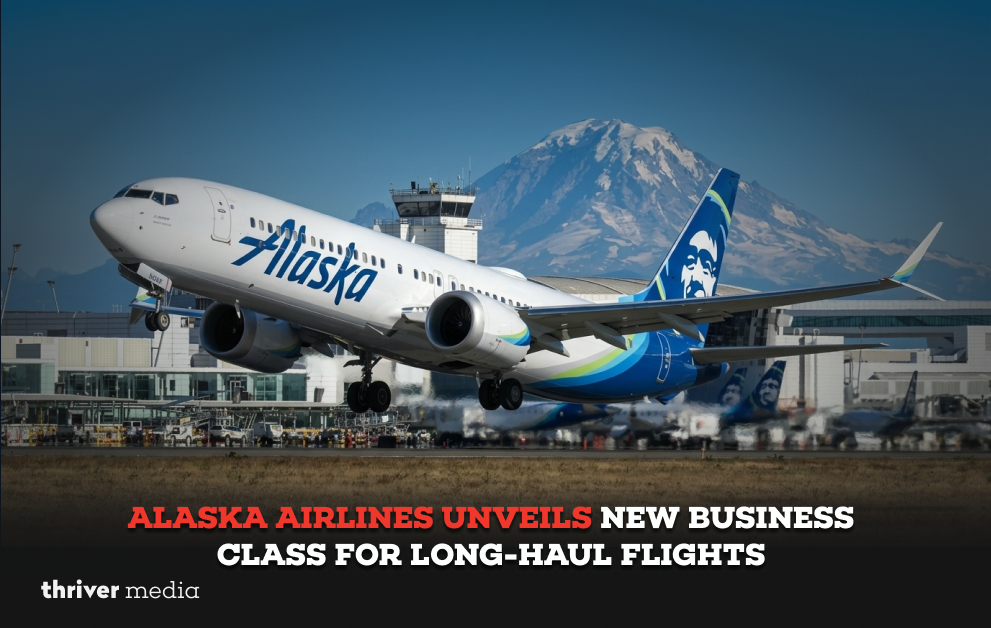
Alaska Airlines unveils new business class for long-haul flights
Rayha
8th April 2026
Lie-flat suites, gourmet dining, and routes to Europe and Asia how Alaska’s bold premium play stacks up against the competition.
Alaska Airlines enters the global premium market with new International Business Class Suites launching spring 2026 on long-haul Dreamliner routes.
For years, Alaska Airlines was synonymous with reliable domestic service along the West Coast. That reputation is changing fast. On March 31, 2026, the carrier officially unveiled its first-ever International Business Class Suites—a fully redesigned premium cabin launching on Boeing 787-9 Dreamliners this spring.
With nonstop routes from Seattle to Rome, London, Reykjavík, Seoul, and Tokyo either live or planned, Alaska is no longer content to remain a regional favorite. It wants a seat at the global table.
The timing matters. Airlines industry-wide are pouring investment into premium cabins because business and first-class tickets generate outsized revenue relative to economy. Delta has its Delta One Suites, United is rolling out Polaris Studio, and American recently introduced Flagship Suites. Alaska’s entry raises an important question: can a carrier built on short-haul efficiency deliver a long-haul luxury product that truly competes?
This guide breaks down everything travelers need to know from seat design and dining to route plans, pricing, and how the new premium offering stacks up against the competition.
Business Class Seat Design: Lie-Flat Suites with Full Privacy
The centerpiece of the new cabin is a set of 34 fully enclosed lie-flat suites arranged in a 1-2-1 configuration. That layout guarantees direct aisle access from every single seat, eliminating the need to climb over a neighbor on overnight flights. Each suite features a privacy door, converting the space into an individual pod that can be used as a seated workspace during the day and transformed into a full-length flat bed at night.
The seats themselves are the Collins Aerospace Elevate Ascent model the same platform being installed on new American and United 787s. Alaska has customized them with premium bedding produced in partnership with Filson, the Pacific Northwest outdoor brand. Passengers receive a lumbar pillow, mattress pad, and duvet designed specifically for the cabin. An amenity kit from Los Angeles-based Salt & Stone rounds out the comfort package with skincare essentials, a sleeping mask featuring destination skyline artwork, and a reusable water bottle.
For a carrier that until recently had no enclosed business-class product at all, this is a significant leap. The hardware itself is competitive with what Delta, United, and American offer on comparable routes though it does not quite reach the extravagance of Middle Eastern or Asian carriers like Qatar Airways or Singapore Airlines.
Key Suite Features at a Glance
1-2-1 Suite Layout: Every passenger gets direct aisle access no climbing over neighbors.
Full Lie-Flat Bed: Seats convert into flat beds with Filson-designed bedding, lumbar pillow, mattress pad, and duvet.
Privacy Door: Enclosed pod-style suites with a closing door for true personal space.
Premium Amenity Kit: Salt & Stone skincare, destination-themed sleeping masks, and a reusable water bottle.
In-Flight Entertainment and Connectivity
Alaska Airlines enters the global premium market with new International Business Class Suites featuring privacy doors, lie-flat beds, and West Coast-inspired dining launching spring 2026 on Seattle routes to Rome, London, Tokyo, and Seoul.
Each suite is equipped with an 18-inch HD touchscreen loaded with hundreds of hours of movies, television, and curated content libraries. Noise-reducing headsets are provided, and personal power outlets plus wireless charging keep devices topped up throughout the flight.
Connectivity is the one area where Alaska’s launch product falls short at least temporarily. The airline has confirmed plans to install Starlink satellite Wi-Fi on its 787 fleet, but certification for this specific Dreamliner variant is still pending. Current estimates place the Starlink rollout in fall 2027, meaning passengers flying these routes during the 2026 summer season will lack onboard Wi-Fi. For business travelers who rely on staying connected during transatlantic or transpacific flights, this is a notable gap compared to competitors like Delta and United, which already offer satellite-based Wi-Fi on most long-haul aircraft.
Dining: Restaurant-Quality Meals at 35,000 Feet
Alaska has clearly invested heavily in the food and beverage program, leaning into a West Coast culinary identity that distinguishes it from the broader competition. The dining experience unfolds in stages:
Pre-Departure
Business class passengers are welcomed with a cheese and charcuterie board paired with an expanded beverage selection that includes champagne, craft cocktails, and premium wines from West Coast and European vineyards.
Multi-Course Main Service
The meal service offers up to six entrée choices, and menus are tailored by destination. Flights to Rome may feature Italian-inspired dishes like roasted chicken with pasta carbonara, while Seoul-bound passengers can expect gochujang chicken served with traditional Korean banchan sides. A rotating Chef’s Table entrée, created in partnership with a respected Seattle-based chef, adds a premium culinary layer.
Dessert and Pre-Arrival
Dessert includes a customizable sundae service featuring Salt & Straw ice cream and artisanal sweets. Pre-arrival meals are also destination-specific expect a full English breakfast on London routes. Passengers can pre-order meals through the Alaska app before boarding, a convenience feature that ensures their preferred dishes are reserved.
Cabin Layout and Passenger Experience
The overall cabin has been designed to feel like a lounge rather than a traditional aircraft interior. The 1-2-1 configuration across 34 suites gives the space an open, uncrowded feel while still preserving privacy for individual travelers and couples in the center pairs. Business class passengers also receive priority lounge access at departure airports.
It is worth noting that these 787-9 Dreamliners were originally ordered for Hawaiian Airlines before Alaska completed its acquisition in late 2024. Alaska has repurposed and redesigned the aircraft for its own international expansion, meaning the hard product shares DNA with what Hawaiian previously operated — though the soft product (food, bedding, amenities, service) is entirely new and distinctly Alaska-branded.
Beyond business class, Alaska has also upgraded the experience for all long-haul passengers. International Premium Class offers four extra inches of legroom, 12-inch HD screens, complimentary alcoholic beverages, and a Filson amenity kit. Even main cabin passengers receive complimentary meals and a Filson blanket and pillow on these routes.
Target Routes and Expansion Plans
The International Business Class Suites launch alongside Alaska’s most ambitious international schedule to date, all anchored at Seattle-Tacoma International Airport:
Seattle → Rome (Fiumicino) Daily from April 28, 2026 on 787-9
Seattle → Seoul (Incheon) April 2026 on 787-9
Seattle → London (Heathrow) Daily from May 21, 2026 on 787-9
Seattle → Reykjavík (Keflavík) May 28, 2026 on 737 MAX 8 (tailored premium, not full suites)
Seattle → Tokyo Fall 2026 on 787-9
Alaska’s membership in the oneworld alliance (with Hawaiian Airlines slated to join in 2026) significantly extends the practical reach of these routes. Passengers can connect seamlessly to over 900 destinations worldwide on a single ticket, making Seattle a credible alternative to routing through hubs like Chicago, Dallas, or New York.
Pricing and Potential Concerns
Premium travel does not come cheap. Based on published fares for the Seattle-to-London route in summer 2026, business class tickets start at approximately $8,900 round-trip roughly five to seven times the cost of economy on the same flight. Economy saver fares begin around $1,380, with main cabin around $1,580 and premium class near $2,030. Award tickets through Alaska’s Atmos Rewards program have been spotted in the range of 75,000 to 210,000 points each way, depending on availability and booking timing.
There are a few areas worth watching critically. The lack of Wi-Fi until fall 2027 is a genuine drawback for business travelers who expect connectivity on long-haul flights competitors already offer this. The small cabin size (34 suites) limits award availability and upgrade opportunities, which may frustrate loyal Alaska flyers. And while Alaska’s soft product looks strong, the airline is still unproven on long-haul international routes; service consistency across thousands of flights remains to be seen.
Finally, Alaska faces a challenging financial backdrop. The airline recently disclosed rising fuel costs and demand headwinds, with its stock down over 25% year-to-date as of early April 2026. Whether Alaska can sustain premium investment during a period of financial pressure is a legitimate question.
How Alaska Compares to the Competition
The table below offers a snapshot comparison of Alaska’s new International Business Class against the premium long-haul products from Delta, United, and American on comparable routes as of April 2026.
Feature
Alaska Airlines
Delta One Suites
United Polaris
American Flagship
Seat Comfort
Lie-flat suites, 1-2-1, Filson bedding
Lie-flat suites, 1-2-1, Westin bedding
Lie-flat pods/suites, 1-2-1, Saks bedding
Lie-flat suites, 1-2-1, Casper bedding
Privacy
Full privacy door on all suites
Full privacy door on suites
Doors rolling out on Studio; older Polaris has partitions
Full privacy door on Flagship Suites
Food Quality
Route-specific menus, 6 entrées, Chef’s Table, Salt & Straw desserts
Fully enclosed lie-flat suites with privacy doors, route-specific gourmet dining, Filson bedding, Salt & Stone amenity kits, and 18-inch HD entertainment screens all on Boeing 787-9 Dreamliners.
Will it be available on all Alaska Airlines flights?
No, initially limited to long-haul international routes from Seattle on 787-9 aircraft (Rome, London, Seoul, Tokyo). Reykjavík service uses a 737 MAX with a different premium product.
Is Alaska Airlines business class worth the price?
It depends on your priorities. The hardware and dining are competitive with Delta, United, and American. The lack of Wi-Fi until 2027 and limited route network are drawbacks. Award bookings through Atmos Rewards can offer better value.
How does it compare to competitors like Delta One and United Polaris?
Broadly competitive on seat comfort and privacy. Alaska’s dining program is distinctive. However, Delta and United have larger route networks, established service consistency, and functioning Wi-Fi advantages that matter on long-haul flights.
When do the new routes launch?
Seattle to Rome begins April 28, 2026. London follows on May 21, Reykjavík on May 28, and Tokyo is planned for fall 2026. Seoul service is already underway.
Conclusion: Alaska Is Playing a Bigger Game Now
Alaska Airlines’ International Business Class Suites represent the most significant premium investment in the carrier’s history. By combining competitive lie-flat hardware with a thoughtfully crafted West Coast dining and amenity program, Alaska has assembled a product that belongs in the same conversation as Delta One, United Polaris, and American Flagship Suites something that would have been unthinkable just a few years ago.
The strategic logic is sound. Premium cabins drive disproportionate revenue, and Alaska’s Seattle hub positions it well to capture demand from the Pacific Northwest’s tech-heavy, travel-affluent demographic. The oneworld alliance extends its reach globally. And the Hawaiian Airlines merger gave Alaska access to the widebody aircraft it needed to make this leap.
That said, this is still a carrier proving itself in a new arena. The Wi-Fi gap is real. The route network is small compared to legacy competitors. And financial headwinds add uncertainty around sustained investment. Whether Alaska can match its strong launch promises with consistent execution over thousands of flights will ultimately determine if this product earns lasting loyalty or remains a promising debut that struggles to scale.
The Bottom Line
Alaska Airlines has delivered a strong, credible upgrade that puts it squarely in the premium long-haul conversation for the first time.
The lie-flat suites, destination-driven menus, and West Coast identity give it genuine character. But real value will depend on execution, pricing competitiveness, and how quickly Alaska addresses the Wi-Fi gap.
For West Coast travelers especially those loyal to Alaska’s Atmos program it is absolutely worth watching. For everyone else, it is a promising new option in a market that benefits from more competition.
Disclaimer: The news and information presented on our platform, Thriver Media, are curated from verified and authentic sources, including major news agencies and official channels.
Want more? Subscribe to Thriver Media and never miss a beat.