

Technology & Innovation | Artificial Intelligence | Neuroscience Published March 2026

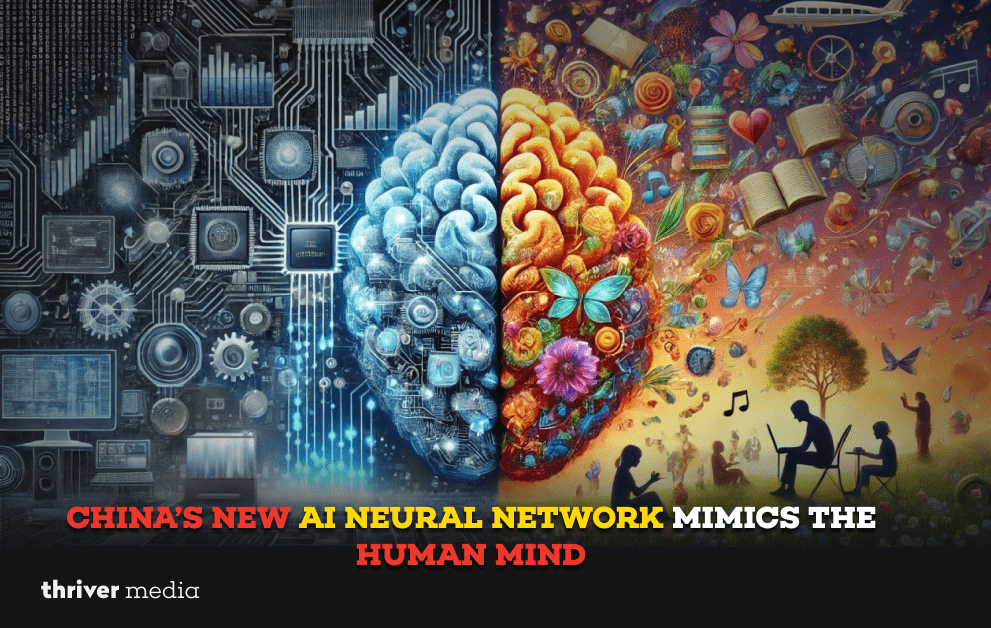
China New AI Learns the Way We Do
Imagine handing a young child a single picture of a cat. Within seconds, that child can recognise every other cat it ever encounters, spotted in a garden, drawn in a book, or glimpsed on a screen. No spreadsheet of labelled examples is needed. No million-row dataset is required. The human brain simply forms a concept and carries it forward.
Current artificial intelligence systems cannot do this. State-of-the-art deep learning models, the engines powering everything from image classifiers to large language models, are voracious consumers of data. They are trained on billions of examples, fed through layer after layer of mathematical transformations, and still they lack something fundamental: the ability to form a concept from a handful of real-world experiences and apply it independently.
That gap between machine learning and human cognition has challenged researchers for decades. But a new breakthrough from China may have brought science one significant step closer to bridging it. Researchers from the Institute of Automation of the Chinese Academy of Sciences and Peking University have developed a novel artificial intelligence neural network that learns and applies concepts much the way the human brain does, building understanding from images and sounds rather than from mountains of labelled text.
This is not incremental progress. It is a fundamentally different way of thinking about how AI systems can acquire and share knowledge. And the implications extend far beyond computer science.
“The system creates concepts from raw sensory input images, sounds, and experiences without being told what those concepts should be.”
The Problem With Current AI: Drowning in Data
To understand why this research matters, it helps to understand how conventional AI systems learn. Most modern neural networks, including the transformer architectures behind today’s most powerful language models, are trained through supervised learning. They are shown enormous quantities of labelled data: millions of images tagged with descriptions, billions of sentences annotated for meaning, vast libraries of code linked to documentation.
This approach has produced genuinely remarkable results. Image recognition systems can now outperform human radiologists in detecting certain tumours. Language models can write poetry, summarise legal documents, and generate functional code. The outputs are impressive.
But the process is deeply inefficient. It requires extraordinary quantities of data. It demands enormous computing infrastructure. And crucially, knowledge learned in one domain cannot easily be transferred to another. A model trained to identify birds cannot simply apply that knowledge to recognise fish; it must be retrained, often from scratch, on a new labelled dataset.
The human brain operates entirely differently. Humans learn through abstract, flexible representations that can be applied across contexts, combined in new ways, and communicated between individuals without sharing the underlying raw experiences that generated them.
The Breakthrough: A Neural Network That Thinks in Concepts

The research team at the Institute of Automation of the Chinese Academy of Sciences, collaborating with scientists at Peking University, has developed a new neural network architecture to autonomously generate, store, and apply concepts.
Unlike conventional models that process raw data and produce outputs through a single end-to-end pipeline, this system is built around a two-component structure that separates concept creation from concept application. The distinction is subtle but transformative.
The first component, the concept generator, processes raw sensory inputs such as images and sounds. Rather than simply classifying those inputs or predicting outputs, this component extracts higher-order representations and organises them into an internal structure the researchers call a “concept space.” These concepts are not predefined by human engineers. They emerge from the system’s own processing much as the concept of “roundness” emerges in a child’s mind from encountering balls, plates, and bubbles.
The second component, the concept applicator, draws on the populated concept space to perform downstream tasks. Image recognition, decision-making, and categorisation are all handled not by processing raw data again, but by reasoning over the abstract concepts that have already been formed. The system, in essence, thinks before it acts.
“One part of the system forms the concepts. The other uses those concepts to understand the world exactly as the human brain separates perception from cognition.”
Key Components of the AI Model: A Technical Overview
The following table summarises the core features that define this new neural architecture and distinguish it from conventional deep learning approaches:
| Feature / Component | Mechanism | Significance |
| Concept Creation | Unsupervised extraction from images and sounds | AI forms abstract representations without labelled datasets, mirroring how the brain builds understanding from raw experience |
| Concept Application | Downstream reasoning via stored concept space | Tasks such as image recognition and decision-making are performed by reasoning over concepts rather than re-processing raw data |
| Internal Concept Space | A shared representational layer between modules | Acts as the AI equivalent of working memory — storing generalisable knowledge that can be accessed and reused across tasks |
| Knowledge Sharing | Concept transfer between AI agents without raw data exchange | Multiple AI systems can share learned knowledge by exchanging concepts, eliminating the need for each system to retrain from scratch |
| Brain-Like Processing | Two-stage architecture separating perception and cognition | Structurally mirrors the distinction between sensory processing and higher-order thinking observed in human neuroscience |
| Multi-Modal Input | Accepts both visual (image) and auditory (sound) data | Enables the system to build richer, more contextual concepts from multiple sensory streams simultaneously |
Inside the Concept Space: AI’s Answer to Memory
The most conceptually striking element of this research is the internal concept space, a structured representational layer that sits between the two halves of the neural network. Think of it as the AI system’s long-term memory for abstract ideas.
When the concept-generating component processes a new image or sound, it does not simply store a compressed copy of that input. Instead, it constructs an abstract representation of a point or region in a multi-dimensional concept space that captures the meaningful properties of the experience. An image of a dog, a sound of barking, and a photograph of paw prints might all contribute to and reinforce the same conceptual region.
This structure has a powerful side effect: it makes knowledge shareable. Because concepts are represented as structured positions within a shared space rather than as raw data, two AI systems built on this architecture can exchange knowledge by sharing their concept spaces directly. One system that has learned to recognise natural landscapes can transfer that conceptual understanding to another system without sharing the thousands of images that generated it.
The researchers liken this to the way humans share knowledge through language. When one person tells another that a particular fruit is bitter, the second person acquires a concept without having tasted it. The concept, not the raw experience, is what travels.
Why This Breakthrough Matters: Implications for AI and Beyond
The significance of this research extends across several fields simultaneously, and it is worth unpacking each dimension carefully.
For Artificial Intelligence Development
The most immediate implication is efficiency. Current large-scale AI systems are extraordinarily expensive to train. The computational and energy costs associated with training a frontier language model are estimated to run into tens of millions of dollars. Data acquisition, annotation, and storage represent additional layers of cost and complexity.
A concept-based architecture could dramatically reduce these burdens. If AI systems can form generalisable concepts from limited sensory input and share those concepts without re-processing raw data, the entire economics of AI development begins to shift. Smaller organisations, research institutions, and developing nations could deploy capable AI systems without requiring access to the massive data infrastructure currently necessary.
For Machine Learning Efficiency
One of the persistent frustrations in applied machine learning is transfer learning, the challenge of transferring knowledge from one domain to another. Despite considerable progress, models still struggle to generalise across contexts as intuitively as humans do.
Concept-based learning offers a principled solution. Because concepts are abstract and context-independent by design, a system that has learned the concept of “fragility” from glass objects should be able to apply it to new materials without explicit retraining. This kind of genuine generalisation has been the holy grail of AI research for years.
For Neuroscience Research
Perhaps the most fascinating implication is scientific rather than commercial. Neuroscientists have long theorised that the human brain’s remarkable efficiency stems from its ability to form and manipulate abstract concepts rather than storing raw sensory data. The visual cortex, the hippocampus, and the prefrontal cortex appear to cooperate in a system not entirely unlike the two-component architecture described in this research.
By building AI systems that mirror this structure, researchers gain a new tool for testing and refining theories of cognition. If a concept-based AI exhibits the same patterns of generalization, error, and creativity that humans show, it provides evidence that the underlying theoretical model of human cognition is on the right track.
Frequently Asked Questions
What is a concept-based neural network, and how is it different from standard deep learning?
It separates concept creation from task execution, allowing AI to reason using abstract ideas instead of relying on large labelled datasets.
What role does the “concept space” play in this AI system?
It acts as the AI’s internal memory where abstract concepts are stored and used to perform tasks or share knowledge.
Can this AI learn from images and sounds without massive datasets?
Yes, it can extract meaningful concepts from relatively small amounts of visual and audio data.
How does concept-based AI improve knowledge sharing between systems?
AI systems can exchange learned concepts directly instead of retraining on the same raw data.
What challenges still exist with this approach?
Researchers must ensure concepts are accurate, unbiased, and scalable for complex real-world environments.
The Bottom Line
The neural network developed by researchers at the Institute of Automation of the Chinese Academy of Sciences and Peking University represents one of the more genuinely novel contributions to AI architecture in recent years. By separating concept formation from concept application and introducing a shared internal concept space for storing and transferring knowledge, the team has built a system that does something current AI cannot reliably do: learn the way humans learn.
The implications ripple outward in several directions at once. AI development could become less dependent on massive datasets and the expensive infrastructure required to process them. Machine learning systems could achieve the kind of genuine generalisation that has eluded the field for decades. And neuroscience could gain a new computational tool for modelling and testing theories of human cognition.
None of this will happen overnight. Research at this level requires extensive validation, peer scrutiny, and real-world testing before its claims can be considered fully established. But the direction is clear and exciting.
“Concept-based AI is not just a technical upgrade it is a philosophical shift in how we think about machine intelligence.”
Conclusion: The Next Generation of Intelligent Systems
For most of AI’s history, the gap between machine learning and human cognition has been framed as a problem of scale. Give the machines more data, more compute, more parameters, and eventually they will reach human-level intelligence. That framing has produced remarkable results, but it has also produced systems that are brittle, expensive, and fundamentally unlike the minds they are meant to emulate.
The research emerging from China suggests a different path. Instead of scaling up the same architecture, the team has rethought the architecture, building a system that learns through concepts rather than data accumulation. In doing so, they have created something that does not just process the world more efficiently. It understands it differently.
The implications for the next generation of intelligent systems are profound. AI that can form concepts from limited experience, apply those concepts flexibly across contexts, and share knowledge without raw data exchange is AI that can operate in the real world, messy, unpredictable, and resource-constrained in ways that current systems simply cannot.
The human mind remains the most sophisticated information-processing system ever observed. For the first time, artificial intelligence may be beginning to learn not just from human data, but from the human example of how to learn at all.
The concept has been formed. Now it must be applied.
Disclaimer: The news and information presented on our platform, Thriver Media, are curated from verified and authentic sources, including major news agencies and official channels.
Want more? Subscribe to Thriver Media and never miss a beat.