

19 February 2026
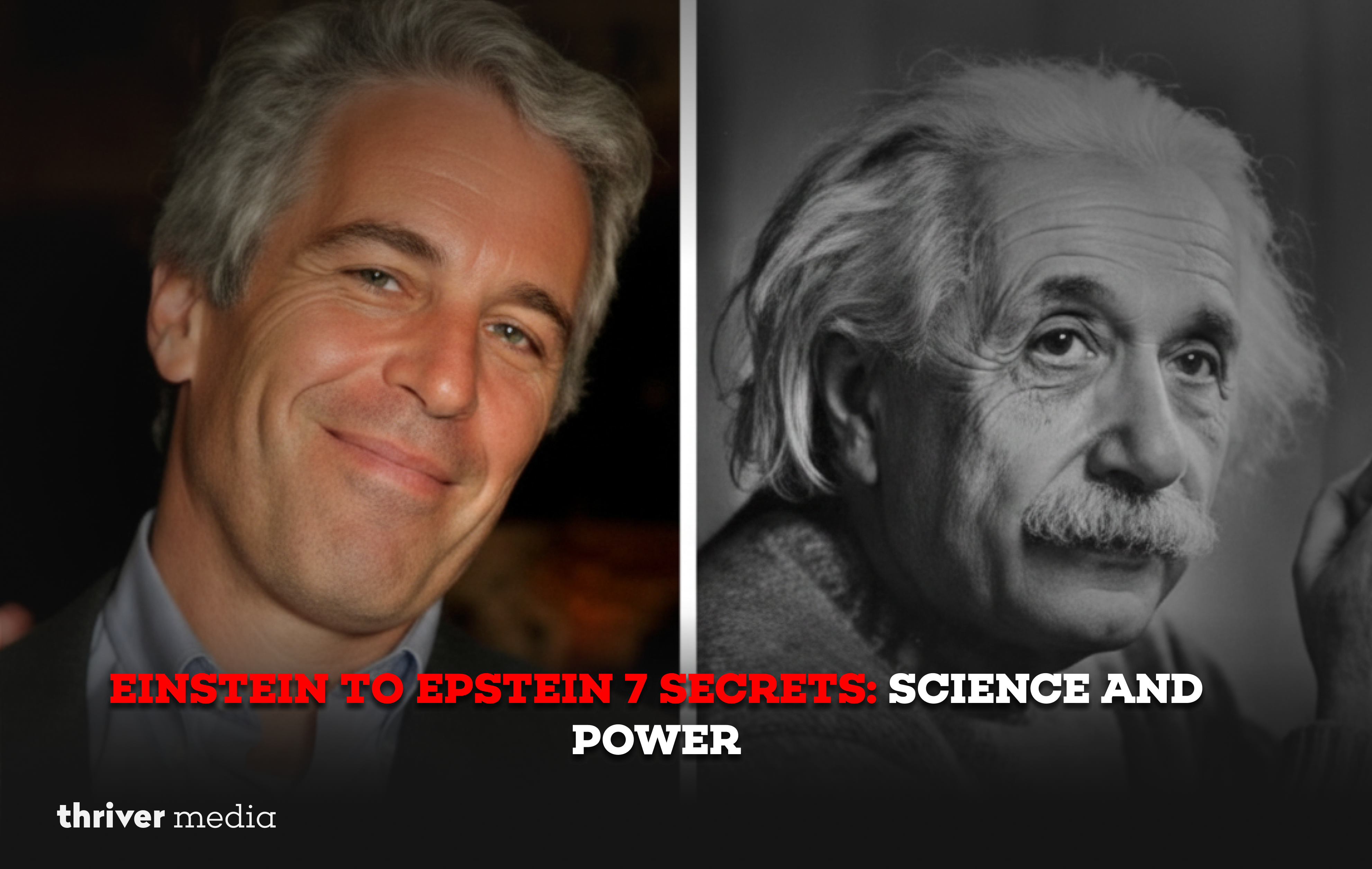
The human mind contains multitudes. It can unravel the mysteries of the cosmos while remaining willfully blind to the suffering in its own living room. It can pen passionate letters about justice and peace while enabling systems of exploitation. This uncomfortable truth sits at the heart of one of the most troubling questions of our time: How did we get from Albert Einstein the wild-haired pacifist who gave us relativity to Jeffrey Epstein the financier who gave us a trafficking empire?
The answer isn’t simple. It winds through Ivy League corridors, across private island beaches, and deep into the human psyche’s capacity for compartmentalization. Along the way, it reveals something profound about brilliance, morality, and the seductive power of proximity to greatness.
| The Two Poles | Albert Einstein | Jeffrey Epstein |
|---|---|---|
| Symbolizes | Moral ambition, conscience-driven intellect | Moral anesthesia, intellect without ethics |
| Relationship to Power | Surveilled by FBI for radical views | Cultivated power for personal gain |
| Scientific Legacy | Revolutionized physics, quantum theory pioneer | Exploited scientists’ prestige for access |
| Ethical Stance | Pacifist, civil rights advocate, anti-nuclear | Enabler of systematic exploitation |
| Jewish Identity | Embraced Jewish ethics and responsibility | Represented betrayal of those values |
| Final Assessment | 9.33/10 on universal ethics scale | Symbol of moral bankruptcy |
The Einstein Standard: Brilliance With Conscience
Before we examine the fall, we must understand the height from which we descended. Albert Einstein wasn’t merely a genius he was a particular kind of genius, one who understood that intellectual power without moral compass becomes destruction.
When Einstein Wrote Letters of Recommendation for Paul Epstein
In 1921, at the height of his international fame, Einstein sat down to write a letter for his friend and colleague, physicist Paul Epstein. The letter, now preserved by rare book dealers and historians, reveals something crucial about Einstein’s character .
Einstein described Epstein as “certainly one of the most prominent living theoretical physicists of the German-speaking world.” He detailed Epstein’s groundbreaking work on quantum theory, particularly his analysis of the Stark effect, which provided “one of the strongest supports for the Rutherford-Bohr atomic theory.“
But here’s what makes the letter remarkable: Einstein didn’t stop at professional qualifications. He added a personal touch that speaks volumes about his values. “I would like to add,” Einstein wrote, “that I have also come to appreciate Mr. Epstein in personal interactions as a human being, and that I had the pleasure of attending several scientific lectures given by him, which enabled me to convince myself of his competence in delivering clearly understandable oral exposition” .
This wasn’t just a letter of recommendation. It was a testament to Einstein’s belief that character matters that being a “human being” in the fullest sense was as important as scientific achievement. Paul Epstein would go on to join the California Institute of Technology, contributing to physics for decades.
Einstein’s Quantum Letters Reveal His Playful Brilliance
Einstein’s correspondence with Paul Epstein wasn’t limited to job recommendations. Throughout the 1940s, the two physicists exchanged letters wrestling with the deepest mysteries of quantum mechanics .
In one remarkable letter written before November 1945, Einstein put a new spin on his famous phrase “God does not play dice.” He wrote to Epstein: “In other words, God tirelessly plays dice under laws which he has himself prescribed” . The playfulness masks profound seriousness Einstein grappling with quantum entanglement, which he described as “spooky action at a distance.“
These letters show Einstein at his best: rigorous, humble, and willing to admit uncertainty. “My private opinion is this,” he wrote. “The quantum theory in its present form is a highly successful experiment, undertaken with inadequate means (concepts)” . Even in disagreement, he respected the pursuit of truth above being right.
Why the FBI Kept a 1,400-Page File on Einstein
Here’s a detail that shocks most people: the United States government spied on Albert Einstein for decades. His FBI file ballooned to 1,427 pages by the time of his death in 1955 .
Why surveil the most famous scientist in America? Because Einstein refused to limit his concerns to physics. He spoke out against segregation, befriending civil rights icon Marian Anderson and inviting her to stay at his home when hotels denied her entry. A critic of unchecked capitalism, he also warned about the dangers of rising militarism. Later in life, after helping initiate the atomic bomb project, he became a strong advocate for nuclear disarmament.
J. Edgar Hoover branded Einstein “an extreme radical.” The charge was accurate if you define radical as someone who believes intelligence must serve humanity. Einstein once wrote: “I regard class differences as contrary to justice and, in the last resort, based on force” . To Hoover, such words were dangerous. To history, they’re evidence of a life well-examined.
Grading Einstein’s Ethical Legacy
One researcher recently attempted something audacious: grading Einstein against universal ethical principles. Using a framework of three natural laws system integrity, feedback reception, and balance the assessment gave Einstein a 9.33 out of 10 .
The evaluation noted Einstein’s “exceptional system correction” through revolutionizing physics, his “deep engagement with global feedback” through dialogue with thinkers across disciplines, and his “mostly balanced life of reason, ethics, and compassion” . The only deductions came from his early support for the atomic bomb (later regretted) and occasional rigidity in personal relationships.
This isn’t hagiography. Einstein had flaws complicated relationships with family, moments of intellectual stubbornness. But he never stopped asking whether his gifts served good or harm. That question, consistently asked, made all the difference.
The Epstein Abyss: Brilliance Unmoored
Now we arrive at the uncomfortable part. Jeffrey Epstein wasn’t stupid. He was, by many accounts, remarkably intelligent a fact that makes his crimes more disturbing, not less.
How Scientists Got Entangled in the Epstein Machine
The recently released Epstein Files, published under the Transparency Act, reveal a disturbing pattern: Epstein actively cultivated relationships with scientists . His assistants contacted researchers, arranged meetings, dangled funding prospects. If you showed sufficient interest, you might receive dinner invitations at his Manhattan mansion, rubbing shoulders with other celebrities while Epstein hinted at financial support for your work.
Many scientists appear in the files. Brian Greene, the physicist and Science Festival founder, met with Epstein likely as part of fundraising efforts. Other prominent researchers appear in emails, schedules, and correspondence .
The critical question: Did these scientists know about Epstein’s crimes? Most say no, and the files don’t prove otherwise. Epstein’s double life was carefully compartmentalized. But as one scientist’s mother wisely advised: “Be careful not to get sucked up in the slime-machine going on here! Since you don’t care that much about money, they can’t buy you at least” .
Harvard’s Complicated Connection to the Scandal
Epstein focused intensely on Harvard. Emails show him arranging meetings, promising research support, cultivating relationships with faculty and administrators . Harvard conducted its own investigation in 2020, but the newly released files have reopened questions about what university leaders knew and when.
This isn’t about blaming institutions for a predator’s deception. It’s about recognizing how easily prestige-seeking can blind smart people to moral rot. When Epstein walked Harvard’s halls, he wasn’t wearing a warning label. He wore wealth, connections, and apparent generosity all of which can look indistinguishable from legitimacy.
The Cultural Slide From Moral Ambition to Moral Anesthesia
One blog post circulating during the Epstein Files release posed a haunting question: “How did we get from Einstein to Epstein?”
The author traces a century-long arc in Jewish intellectual life from Einstein’s generation, which “embodied a distinctly Jewish idea: Intelligence is worthless without conscience,” to a later generation more “fluent in access than ethics. More dazzled by power than conscience. More eager to be close to presidents and princes than philosophers” .
After the Holocaust, the argument goes, a traumatized people made a silent pact with the American Dream: “Never again be powerless. Never again be poor. Never again be shut out.” This was understandable, even necessary. But with success came a new idolatry. The old moral vocabulary responsibility, justice, humility was gradually replaced by a new American one: networking, influence, endowments, real estate, exclusive clubs .
The result? “A class more fluent in access than ethics. More dazzled by power than conscience.” It was only a matter of time before someone like Jeffrey Epstein stepped onto that stage .
The Moral Mathematics of Genius
What explains the difference between Einstein and Epstein? Both were brilliant and sought influence, moving comfortably within elite circles.Yet one used his gifts to illuminate the universe and defend human dignity; the other used his to exploit the vulnerable and corrupt institutions.
Intelligence Without Ethics Becomes Depravity
The blog post puts it starkly: “Einstein was not perfect far from it but he symbolized something that has defined the Jewish people for centuries: an obsession with ideas, ethics, responsibility, questioning, and the search for truth.” Epstein, by contrast, represents “a grotesque symbol of corruption, exploitation, and moral decay” .
This isn’t about ethnicity or religion. It’s about what happens when intellectual ambition mutates into narcissistic ambition when ethical responsibility is traded for elite access. The formula is simple but devastating: brilliance minus conscience equals moral catastrophe.
Why Compartmentalization Enables Evil
Psychologists have studied how smart people do terrible things. The answer often involves compartmentalization the mental ability to hold contradictory beliefs and behaviors in separate boxes. Epstein could fund science while exploiting children because he never connected the two. Scientists could accept his money while ignoring rumors because they never connected their funding to his crimes.
Einstein resisted this temptation. When he recognized his role in enabling nuclear weapons, he didn’t compartmentalize he spoke out, advocated for disarmament, and accepted responsibility . When he saw injustice, he didn’t separate his science from his citizenship he marched, signed petitions, and opened his home.
The Accountability Question for Science
The Epstein Files raise uncomfortable questions for the scientific community. Not about legal culpability most scientists who interacted with Epstein appear to have done nothing illegal. But about moral responsibility: When should researchers ask where money comes from? When does networking become enabling? At what point does silence become complicity?
These questions lack easy answers. Science requires funding. Funding requires wealthy patrons. Wealthy patrons sometimes have complicated histories. But the Epstein case suggests that the scientific community’s hunger for prestige and resources created blind spots willing blindness to what should have been visible.
FAQs
No. The “Epstein” in Einstein’s correspondence was Paul Epstein, a prominent physicist and friend of Einstein with no relation to Jeffrey Epstein.
The Epstein Files don’t show evidence that scientists who interacted with Epstein knew about his trafficking operations. His criminal activities were carefully concealed, though rumors circulated in some circles.
Einstein was targeted for his political activism opposing segregation, speaking against capitalism, advocating nuclear disarmament, and maintaining friendships across racial and ideological lines. J. Edgar Hoover considered him “an extreme radical”.
They were friends and colleagues who corresponded about quantum physics for decades. Einstein wrote a glowing recommendation letter for Epstein in 1921, helping him secure a position at Caltech.
Bottom Line: What This Comparison Teaches Us
The journey from Einstein to Epstein isn’t a straight line. It’s not about two individuals it’s about two possibilities within all of us.
What Einstein represents:
- Intelligence married to conscience
- Success measured by contribution, not access
- Willingness to question power, not cozy up to it
- Recognition that gifts carry responsibility
- Moral ambition that never retired
What Epstein represents:
- Intelligence divorced from ethics
- Success measured by proximity to power
- Eagerness to exploit systems, not improve them
- Belief that wealth excuses everything
- Moral anesthesia that enabled atrocity
The lesson for today:
We live in a world that celebrates brilliance worships it, really. We build platforms for geniuses, fund their work, excuse their flaws. The Einstein-Epstein comparison suggests we need a different metric: not brilliance alone, but brilliance guided by conscience.
Einstein himself understood this. In a world rushing toward nuclear capability, he warned: “The unleashed power of the atom has changed everything save our modes of thinking and thus we drift toward unparalleled catastrophe” . Replace “atom” with “influence” or “wealth” or “genius,”
Official Source Links:
- U.S. Department of Justice Epstein Files
- https://www.justice.gov/epstein/doj-disclosures/data-set-12-files
Conclusion: Reclaiming the Moral Compass
Albert Einstein died in 1955, his FBI file still growing, his warnings about nuclear proliferation unheeded. Jeffrey Epstein died in 2019, his crimes finally public, his connections still reverberating through institutions. Between them lies the distance between two ways of being brilliant one that asked “How can I serve?” and one that asked “How can I take?“
The Jewish tradition, from which both men emerged, has never been afraid of self-rebuke. Prophets did nothing else. The remedy begins where it always has: teaching that intelligence is a gift only when it serves humanity. Teaching that success is meaningless without responsibility. Teaching that the moral universe is real and it always cashes its checks .
From Einstein to Epstein is a fall. But it is not irreversible. It shows us how desperately we must climb back and how urgently we must teach the next generation that brilliance without conscience isn’t brilliance at all. It’s just cleverness, unmoored and dangerous, drifting toward catastrophe.
Disclaimer: The news and information presented on our platform, Thriver Media, are curated from verified and authentic sources, including major news agencies and official channels.
Want more? Subscribe to Thriver Media and never miss a beat.