
12th February 2026
Key Points at a Glance
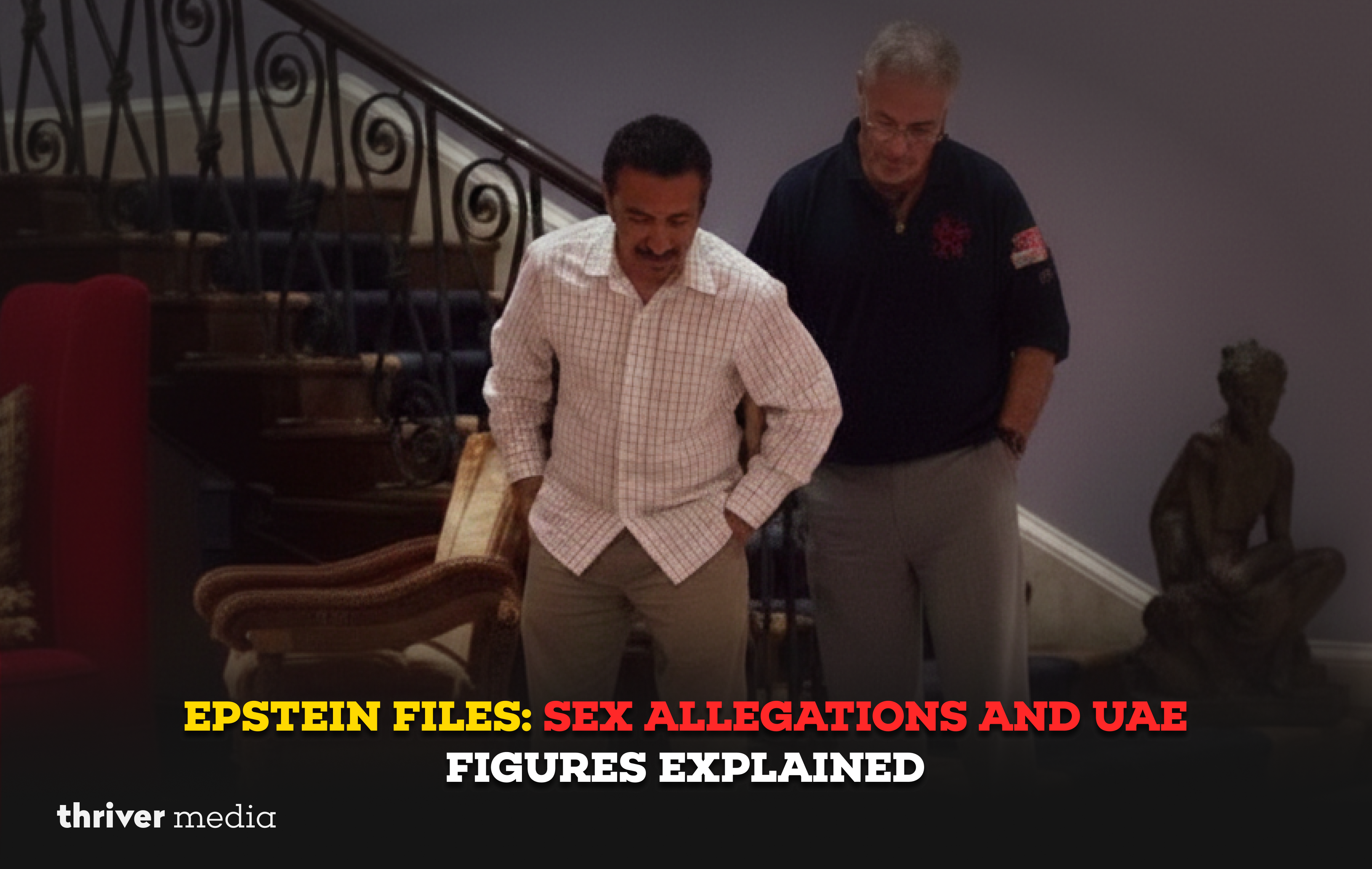
- Newly released Epstein files contain correspondence involving three prominent Emirati figures.
- Emails show post-conviction contact, including references to arranging “girls” and sexually explicit exchanges.
- Documents also allege the shipment of sacred Kaaba cloth (Kiswah) to Epstein’s Florida residence.
- Investigators have filed no charges, and appearing in the files does not amount to guilt.
- The disclosures have triggered investor pauses and religious outrage, highlighting reputational risk over criminal liability.
What’s in This Blog
This article provides a verified breakdown of:
- What the newly released Epstein files actually show
- Which UAE figures the documents reference and the specific allegations tied to each
- Why the Kaaba cloth shipment triggered unique outrage
- The legal context what evidence establishes, what allegations claim, and what remains unverified
- Why these disclosures matter for global elite networks and institutional reputation
- If you want, I can run this same cleanup across headings, bullets, and subheads so the entire
Table of Contents
| Section | Description |
| Overview: The Proximity Problem | How association, not accusation, drives scrutiny in the Epstein files |
| Hind Al-Owais: Diplomat, Emails, and the “Girls” Reference | Email correspondence and why the language raised concern |
| Sultan Ahmed bin Sulayem: DP World, Explicit Emails, and Investor Fallout | Sexually explicit messages and the reputational response |
| Aziza Al-Ahmadi: The Kaaba’s Sacred Cloth and the Florida Residence | Records referencing the Kiswah transfer and public reaction |
| Legal Reality: No Charges, No Convictions | Clear legal status and what the files do not prove |
| Why It Matters: Reputation as the New Liability | How proximity alone can trigger lasting consequences |
Overview: The Proximity Problem
The unsealing of Jeffrey Epstein-related court documents has never been solely about criminality. With Epstein deceased and his enforcer Ghislaine Maxwell convicted, the current disclosure phase serves as a forensic audit of elite access.
The latest files place three prominent Emirati figures in Epstein’s orbit during 2011–2012 years after his 2008 conviction for sex crimes. A mention in the files does not imply guilt, but the correspondence has drawn renewed global scrutiny of judgment, access, and ethical boundaries.
Hind Al-Owais: Diplomat, Emails, and the “Girls” Reference
Role: UAE Diplomat (Human Rights Portfolio)
Timeline: Frequent email contact, 2011–2012
What the Files Show:
Unsealed emails document regular coordination of meetings between Al-Owais and Epstein. Critically, the correspondence includes discussions that reference arranging “girls.”
Why It Matters:
These messages stand in stark contrast to Al-Owais’ public work in human rights advocacy. The documents leave unclear whether anyone carried out arrangements or what the exchanges meant, but the clash between public duty and private correspondence has drawn sharp criticism.
Sultan Ahmed bin Sulayem: DP World, Explicit Emails, and Investor Fallout
Role: Chairman & CEO, DP World (Global Ports Operator)
Timeline: Sexually explicit email exchanges dated after Epstein’s 2008 conviction
What the Files Show:
The files repeatedly name Bin Sulayem and document sexually explicit emails sent years after Epstein’s registered sex-offender status became public.
The Fallout:
While no investor has filed litigation, institutional investors have reportedly paused dealings with DP World. Sources cite reputational concerns rather than legal jeopardy.
Aziza Al-Ahmadi: The Kaaba’s Sacred Cloth and the Florida Residence
Role: UAE-linked figure (alleged facilitation)
Allegation: Shipment of three pieces of the Kiswah the sacred cloth covering the Kaaba in Mecca to Epstein’s Palm Beach residence.
What the Files Show:
Records reference the transfer of these Islamic relics from Saudi Arabia to Florida, allegedly facilitated through UAE-linked contacts. The documents do not explain the purpose, authorization, or recipient intent behind the transfer.
Why This is Different:
Unlike standard financial or social allegations, this detail carries deep cultural and religious weight. The Kiswah is not a commodity; it is a sanctified object. Its alleged presence in the home of a convicted sex offender has sparked outrage across parts of the Muslim world, elevating the discourse from elite gossip to religious sensitivity.
Legal Reality: No Charges, No Convictions
| Category | Status |
| Criminal Charges (UAE Figures) | None filed |
| U.S. Indictments | None pending |
| Judicial Finding of Guilt | None |
| Allegations Proven in Court | None (regarding these three individuals) |
What These Files Are and Are Not
| Aspect | Clarification |
| Document Type | Civil discovery documents, emails, and related records |
| Legal Weight | Evidence of association and proximity |
| What They Do Not Prove | Criminal conduct or legal guilt |
| Current Legal Standing | No court findings against the named individuals |
Why It Matters: Reputation as the New Liability
The Epstein files represent a shift in how elite behavior is judged. Previously, legal clearance was the only metric. Today, ethical clearance is required.
- For Diplomats: Emails referencing “girls” erode soft power and human rights credibility, regardless of prosecution.
- For CEOs: Explicit correspondence with a known offender triggers investor flight not because of fines, but because of brand toxicity.
- For Cultural Figures: The alleged mishandling of sacred objects carries no U.S. criminal penalty, but it carries infinite reputational cost.
- The lesson: Proximity to Epstein post-2008 is not a crime. But it is increasingly viewed as indefensible.
Frequently Asked Questions (FAQ)
No. The documents reference names and correspondence but contain no formal accusations or criminal charges.
Because parts of the correspondence include sexually explicit language or references to arranging “girls,” tied to Epstein’s known pattern of conduct.
The files reference the shipment. They do not confirm delivery, intent, or authorization. The allegation remains unverified.
The files were recently unsealed by the court, making previously private material publicly accessible for the first time.
Reports indicate a pause in dealings by some institutional investors, driven by reputational risk assessments, not legal mandates.
The Bottom Line
No crimes have been charged. No evidence of illegality by these three figures has been proven in court.
What the Epstein files do prove is something the legal system was never designed to adjudicate: a catastrophic failure of judgment.
The correspondence laid bare in these documents ranging from sexually explicit emails to the alleged profane handling of Islam’s holiest relic does not belong to a criminal docket. It belongs to an ethics docket.
- Hind Al-Owais faces scrutiny not over criminality, but over judgment, after emails referenced arranging “girls” with a convicted predator.
- Sultan Ahmed bin Sulayem’s exposure has played out economically, through discreet institutional pullback rather than indictment.
- Questions around Aziza Al-Ahmadi and the Kiswah transfer center on ethics and accountability, not U.S. law specifically how sacred Kaaba cloth entered discovery tied to a Florida sex offender.
The bottom line is binary: You can be legally innocent and ethically compromised. These files prove the latter does not require the former.
Conclusion
The unsealing of the Epstein files was always going to be uncomfortable. It was always going to name names that powerful interests wished to keep private. And it was always going to blur the line between accusation and fact.
In the case of these three Emirati figures, the line remains intact.Authorities have filed no charges. Courts have reached no convictions. No criminal liability applies.
Yet the court of public opinion operates under different rules than the Southern District of New York. It does not require proof beyond a reasonable doubt. It requires only a paper trail.
That paper trail now exists. The files include diplomatic correspondence referencing “girls,” explicit email exchanges involving corporate executives, and records alleging the diversion of sacred religious artifacts to a Florida residence.
Disclaimer: The news and information presented on our platform, Thriver Media, are curated from verified and authentic sources, including major news agencies and official channels.
Want more? Subscribe to Thriver Media and never miss a beat.