
24th March 2026
Iran-US War Zone Impact Analysis 2026
Official Data & Strategic Assessment
Hormuz Executive Summary: A Perfect Storm
Quick insight:
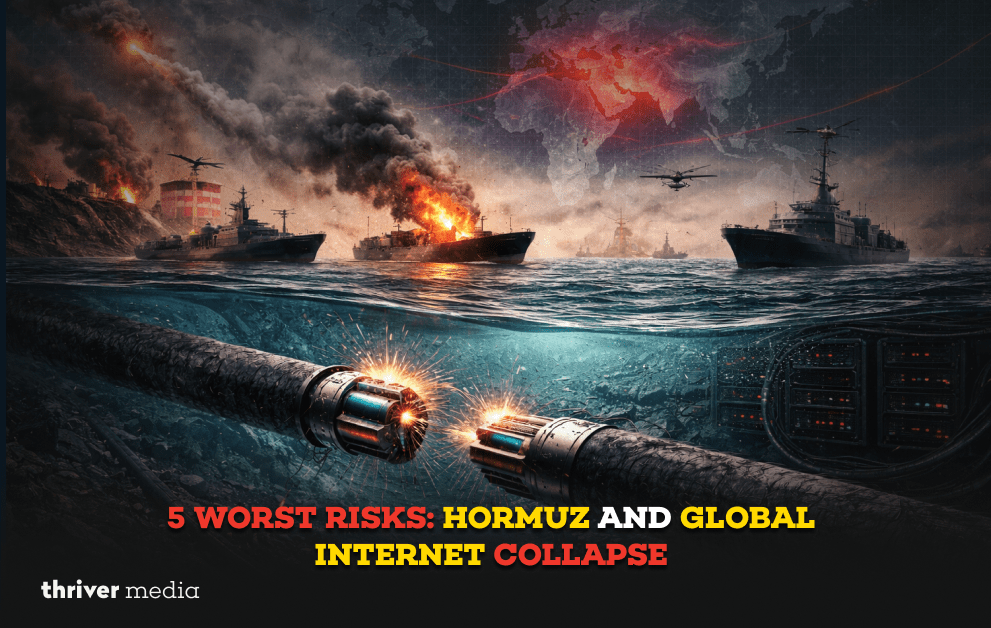
Rising tensions around Hormuz are being linked to risks for undersea cables that carry global data, and any disruption could impact connectivity worldwide.
Since February 28, 2026, when the United States and Israel initiated Operation Epic Fury against Iran, the world has witnessed an unprecedented convergence of two critical chokepoints: the Strait of Hormuz and submarine cable corridors. For the first time in history, both global energy and digital infrastructure face simultaneous disruption.
This analysis examines the five most significant risks to global stability, supported by official government data, congressional testimony, and real-time maritime analytics.
Current Crisis Context: Official Data
| METRIC | PRE-CONFLICT | CURRENT (MARCH 2026) |
| Daily Strait Traffic | ~120 vessels/day | 5-7 vessels/day (95% ↓) |
| Oil Price (Brent) | ~$70/bbl | $119/bbl (+70%) |
| Insurance Premium | 0.125% | 0.2-0.4% ($250k+/tanker) |
| Stalled Vessels | Minimal | 150+ anchored outside |
| Confirmed Attacks | 0 | 21+ (UKMTO verified) |
RISK 1: 20% of Global Oil Supply Disrupted
The Core Threat
According to the U.S. Energy Information Administration (EIA) and Congressional Research Service (CRS), approximately 20 million barrels of oil per day transit the Strait of Hormuz representing one-fifth of global petroleum liquids consumption. One-quarter of all seaborne oil trade flows through this 33-kilometer-wide waterway.
Current Status (March 23, 2026):
- Iran’s Islamic Revolutionary Guard Corps declared the strait effectively closed on March 2-3, 2026
- Tanker traffic has dropped by 70-95% according to maritime analytics firm Kpler
- Over 150 commercial vessels are anchored outside the strait to avoid attacks
- War-risk insurance premiums for transits jumped from 0.125% to 0.2-0.4% (costing large tankers $250,000+ per trip)
Economic Impact:
Brent crude has surged 42.3% since conflict began, approaching $119/barrel. The CRS warns that sustained closure lasting a month could push oil into triple digits, constituting the largest global supply disruption since the 1970s energy crisis.
RISK 2: 17+ Submarine Cables Carrying 30% of Global Internet
The Hidden Crisis
While markets focus on oil, a less visible but potentially more consequential threat looms beneath the waterline. According to industry analysis by Submarine Networks and the International Cable Protection Committee (ICPC):
- 17 submarine cables pass through the Red Sea alone, carrying the majority of data traffic between Europe, Asia, and Africa
- Additional cable systems pass through the Strait of Hormuz, connecting Iran, Iraq, Kuwait, Bahrain, and Qatar
- These cables carry approximately 95-99% of all intercontinental internet traffic
- About 18% of the world’s data transits through these Gulf and Red Sea routes
Infrastructure at Risk:
- Meta’s 2Africa Pearls project declared force majeure on March 12, 2026 the cable-laying vessel Ile de Batz remains stranded off Dammam, Saudi Arabia
- SEA-ME-WE 6 (connecting Asia, Europe, and Africa) is indefinitely delayed
- Google, Amazon, and Microsoft data centers across the Gulf are now stranded without safe connectivity
A simultaneous closure of Hormuz and Red Sea passages would constitute, according to analyst Doug Madory (Kentik), ‘a globally disruptive event‘ affecting billions of people within minutes.
RISK 3: Direct Attacks on Data Centers & Critical Infrastructure
The 2026 Precedent
Iran has already demonstrated intent and capability to target digital infrastructure:
- March 19, 2026: Iran attacked Qatar’s Ras Laffan LNG facility and Duqm port (Oman), causing fuel storage tank damage
- March 2026: Three Amazon Web Services (AWS) data centers in the Gulf confirmed as targets
- March 12-23, 2026: UKMTO reported 16-21 confirmed attacks on merchant shipping
- Iran possesses midget submarines and diver-delivery systems capable of operating at cable-laying depths (50 meters in Hormuz)
Why This Matters:
Saudi Arabia alone has committed $18 billion to hyperscale data center construction. The HUMAIN initiative and SDAIA Hexagon Data Centre (480 megawatts) are now stranded. According to House of Saud analysis, Iranian drones hitting data centers creates a cascading failure: energy costs spike (Brent +42%), data centers become economically unviable, and billions in regional digital infrastructure investments are jeopardized.
RISK 4: GPS Jamming & Navigation Disruption
An Undocumented Threat
Since late February 2026, GPS jamming of uncertain origin has disrupted navigation across the Strait:
- 1,100+ vessels have reported fake GPS signals placing them at airports and nuclear facilities
- The Strait typically handles 120 vessel transits daily; March 1-18 saw only 105 total—a 95% reduction
- Specialized cable repair vessels cannot safely navigate to damaged infrastructure
- If cable damage occurs, repairs normally requiring 2-4 weeks could extend to 2-4 months due to access restrictions
This creates a perverse incentive: once cables are cut, the infrastructure to repair them cannot access the region, turning temporary damage into permanent outage conditions.
RISK 5: Multiplier Effect on Global Inflation & Supply Chains
Energy + Digital = Systemic Collapse
The 2026 conflict has created a unique scenario where energy and digital infrastructure fail simultaneously, multiplying the economic damage:
Energy Crisis Impact:
- Oil: +42.3% (Brent crude at $119/barrel)
- Natural Gas: +57% (European prices nearly doubled in 48 hours)
Digital Infrastructure Crisis Impact:
- Data center electricity costs (dominant operating expense) spike due to energy prices
- Cloud services, AI infrastructure, and financial trading systems lose connectivity
- India’s IT export market ($250+ billion annually) becomes vulnerable
- Gulf remittances to India ($30+ billion annually) at risk due to financial system disruption
Combined Effect: Higher production costs (energy) + operational disruptions (digital) + supply chain chaos = stagflation scenario with global recession implications.
Key Risk Metrics: Official Data
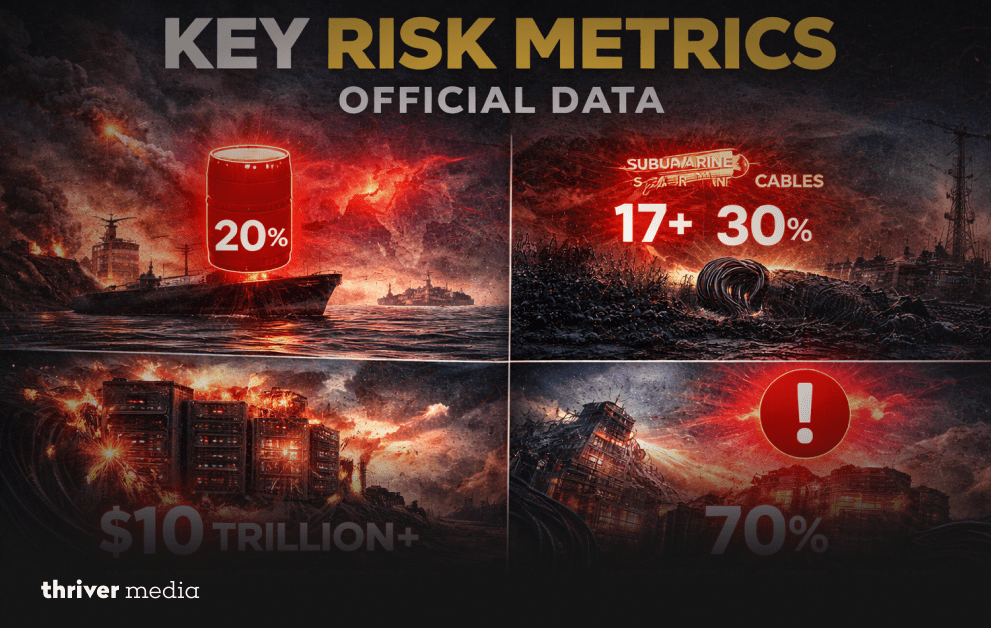
| RISK | SCALE | PROBABILITY (Current) |
| #1: Oil | 20M barrels/day | ACTIVE – 95% closure |
| #2: Internet | 17 cables, 30% global data | HIGH – Both passages closed |
| #3: Data Centers | $18B+ Saudi investment | MEDIUM-HIGH – 3 AWS hit |
| #4: GPS Jamming | 1,100+ vessels affected | ONGOING – Undocumented |
| #5: Multiplier | Energy + Digital collapse | EXTREME – Stagflation risk |
Frequently Asked Questions
Could Iran actually block the Strait of Hormuz permanently?
Legally no, but practically it can disrupt traffic for extended periods through threats and force until external intervention occurs.
What happens if submarine cables are actually cut?
It would cause massive regional outages and slow global internet speeds for weeks or months until repairs are completed.
Are tech companies pulling out of the Gulf?
Not yet, but they are rerouting traffic and pausing projects due to rising instability and risk.
How long can oil prices stay elevated?
Prices can spike for weeks during disruption, but prolonged crises risk triggering a global slowdown that may later reduce demand.
What are governments doing about this?
Governments are deploying military, rerouting resources, and coordinating responses, but no complete solution exists yet.
Could this scenario realistically get worse?
Yes, especially if infrastructure like submarine cables is damaged, escalating it into a global economic and digital crisis.
The Bottom Line
This is not a theoretical scenario. As of March 23, 2026, both the Strait of Hormuz and Red Sea submarine cable corridors are simultaneously compromised an event that has never occurred in modern history.
According to Pentagon assessments and confirmed shipping data:
- Oil market: Supply disruption is the largest since 1973
- Digital infrastructure: For the first time, both data chokepoints are simultaneously closed
- Repair capacity: Specialized cable ships cannot access war zones; damages could take months to fix
- Economic impact: Affects 3+ billion people across Asia, Africa, and Europe
- Resolution: President Trump has extended the five-day negotiation deadline (as of March 23, 2026) with no confirmed breakthrough
The risks are not future risks. They are present-day operational realities.
Conclusion: Strategic Implications
The 2026 Iran-US conflict represents a watershed moment in global infrastructure vulnerability. For decades, geopolitical risk analysis treated energy and digital chokepoints as separate domains. The current crisis has demolished that assumption.
Several realities are now evident:
1. Dual Chokepoint Risk is Real: Simultaneous closure of Hormuz and Red Sea passages, once a theoretical scenario, is now documented reality. No contingency planning had anticipated this.
2. Technology Companies Were Unprepared: Amazon, Google, and Meta invested billions in Gulf data centers betting on geopolitical stability. Their security frameworks focused on cyber threats and supply chain control, not kinetic warfare against undersea infrastructure.
3. Repair Capacity is Insufficient: The global cable repair fleet consists of fewer than 20 specialized vessels. One vessel (Ile de Batz) remains stranded; others cannot access war zones. If multiple cables are severed, the MTTR (mean time to repair) could extend from weeks to months.
4. Alternative Routes Are Overloaded: Shipping companies routing around the Cape of Good Hope and cables bypassing the Middle East are approaching capacity limits. Spare capacity worldwide is approximately 15-20%, far below the 70-95% reduction in Hormuz traffic.
5. Economic Pain is Multiplicative: High energy costs + disrupted data infrastructure + supply chain chaos = stagflationary shock. Global GDP impact estimates range from 0.5% to 2% depending on duration.
Strategic Imperative: The world must fundamentally rethink infrastructure resilience. This requires:
- Diversified submarine cable routing (not clustered in chokepoints)
- Increased cable repair vessel fleet capacity
- Regional data sovereignty initiatives to reduce single-point-of-failure dependencies
- International legal framework protecting critical infrastructure during conflict
- Energy-digital infrastructure coordination at the UN and IMO levels
As of March 23, 2026, President Trump has postponed strikes on Iranian power plants for five days amid negotiations. However, without structural resolution of Iran’s regional isolation and security concerns, the risk of re-escalation remains extraordinarily high.
The Strait of Hormuz and Red Sea are no longer just energy chokepoints. They are now recognized as what they always were: critical infrastructure corridors whose disruption triggers global systemic risk. Treating them as such is no longer optional it is now imperative for global stability.
Official Sources & References
U.S. Energy Information Administration (EIA)
Strait of Hormuz Oil Transit Data
👉https://www.eia.gov/international/analysis/regions-of-interest/Strait_of_Hormuz.php
Congressional Research Service (CRS)
Iran Conflict and the Strait of Hormuz Report
👉https://www.congress.gov/crs-product/IF11856
Disclaimer: The news and information presented on our platform, Thriver Media, are curated from verified and authentic sources, including major news agencies and official channels.
Want more? Subscribe to Thriver Media and never miss a beat.