

4th March 2026

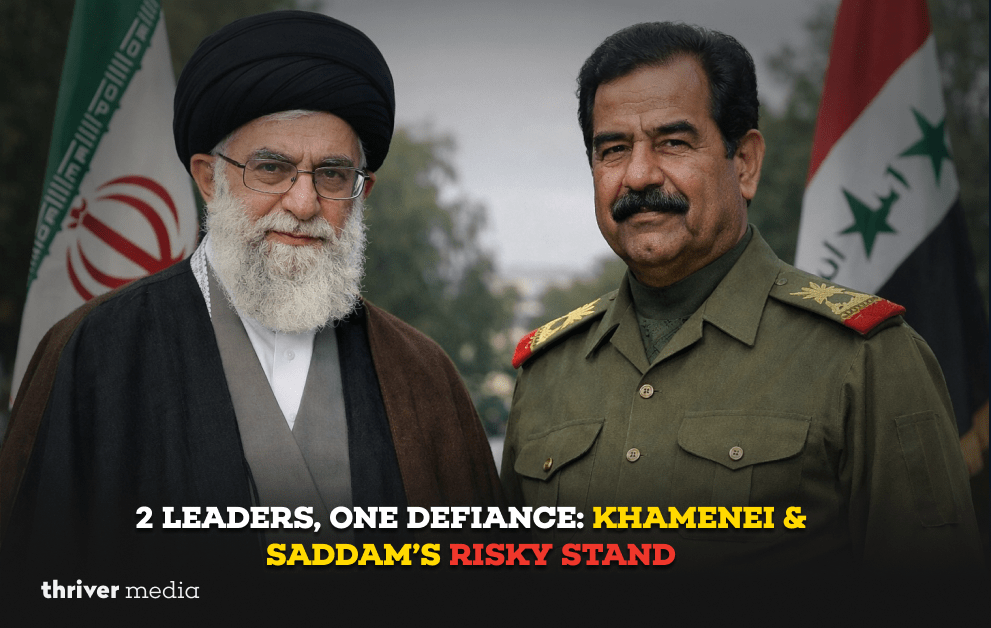
They came from opposite sides of a brutal, eight-year war that left a million dead. One was a secular Arab nationalist who wore Western suits and ruled Iraq with an iron fist. The other is a Shia cleric in a black turban who has led Iran through four decades of revolution, war, and unrelenting defiance. Saddam Hussein and Ayatollah Ali Khamenei: enemies who became each other’s legacy, and two leaders who did what few in the world have dared they stood up to the combined might of the United States and Israel and refused to back down.
On March 1, 2026, the world learned that Khamenei had been killed in joint US-Israeli air strikes on Tehran . President Donald Trump announced that the Supreme Leader “couldn’t escape US intelligence and the advanced tracking systems”. The news sent shockwaves across the globe, but for many, it triggered an uncomfortable memory: another dictator, another regime, another US-led invasion. Saddam Hussein was captured in 2003 and executed in 2006.
The comparison is not lost on anyone least of all Israel. In June 2025, Israeli Defence Minister Israel Katz issued a chilling warning: Khamenei could face a “similar fate” to Saddam Hussein. “Remember what happened to the dictator in the neighbouring country of Iran who took this path against Israel,” Katz said. Now, that warning has become prophecy.
The Timeline: Two Lives, One Trajectory
Before we dive into the analysis, let’s understand who these men were and how their paths intersected with history.
The Core Problem: How the West Distorts the Story
Before we examine the leaders themselves, we must address the fundamental problem with how this topic is discussed in Western media. Understanding this distortion is the only way to see the truth clearly.
The Problem of “Good vs. Evil” Narratives
The Issue: Western media and political leaders consistently frame conflicts with the Middle East as a simple morality play: “freedom-loving democracies” versus “evil dictators.” Saddam Hussein was called a “madman” and a “brutal tyrant” which he was. But what rarely gets mentioned is that the United States supported him for decades when it was convenient.
The Evidence:
- During the Iran-Iraq War (1980-88), the US actively backed Saddam’s Iraq because they feared Iran’s Islamic Revolution.
- Donald Rumsfeld, who would later become US Defence Secretary, met with Saddam in Baghdad to strengthen ties.
- The US provided intelligence, weapons, and diplomatic cover while Saddam used chemical weapons against Iranian forces and Kurdish civilians.
Khamenei himself pointed out this hypocrisy in 2003 when Saddam was captured: “The same Americans who are now happy over his arrest were at the time shaking his hand. The current U.S. defence minister [Donald Rumsfeld] met with Saddam in Baghdad, promised to help him and helped him in order to put Islamic Iran under pressure”.
The Problem of Erasing Context
The Issue: When the West discusses leaders who defy US-Israel policy, they are presented as irrational, fanatical, or simply “evil.” Their actions are stripped of historical context, making defiance seem like madness rather than a calculated response to real experiences.
The Missing Context:
- Khamenei’s deep distrust of the West wasn’t born from ideology alone. It came from living through the 1953 CIA-MI6 coup that overthrew Iran’s democratically elected prime minister, Mohammad Mosaddegh.
- It was forged in an eight-year war where Western powers backed Saddam even as he used chemical weapons on Iranian soldiers and civilians.
- It was reinforced when the US withdrew from the JCPOA in 2018 an agreement Iran had honoured proving that American commitments could not be trusted.
The Problem of Selective Outrage
The Issue: When Israel warns that Khamenei will “meet the same fate as Saddam,” Western media reports it as news without questioning the morality of threatening to assassinate a foreign leader. When Iran responds with equal defiance, it’s framed as aggression.
The Solution: Seeing the Full Picture
The solution isn’t to excuse dictatorship or violence. Saddam Hussein was responsible for atrocities. The Iranian regime has crushed dissent, as seen in the 2009 Green Movement and the January 2026 protests. But understanding why leaders defy the US and Israel requires acknowledging the historical grievances that drive their actions.
As Vali Nasr, an Iranian affairs expert, notes: Khamenei emerged from the Iran-Iraq war “with the assumption that Iran is vulnerable and in need of security; that the US is hostile to Iran; and that the revolution, the Islamic republic and nationalism, are not separated”. That worldview didn’t emerge from nowhere.
The Two Defiers: A Comparative Portrait
1. Saddam Hussein: The Secular Defier
Saddam Hussein ruled Iraq for more than two decades, and his defiance of the US and Israel followed a consistent pattern: challenge Western dominance, posture as the champion of Arab causes, and survive through brutal pragmatism.
The Defiance
- 1980s: Despite receiving Western support against Iran, Saddam maintained a fiercely anti-imperialist rhetoric and positioned Iraq as a leader of the Arab world.
- 1991 Gulf War: After invading Kuwait, Saddam fired 39 Scud missiles at Israel, hoping to provoke Israeli retaliation and shatter the US-Arab coalition against him . He failed Israel, under US pressure, did not retaliate.
- 2003: Even facing the full might of the US military, Saddam refused to go quietly into exile. He chose to fight, then spent eight months on the run before being captured.
The Downfall
Saddam was captured in December 2003, convicted of crimes against humanity, and executed on December 30, 2006. His downfall sent a clear message: defying America could cost you everything.
The Irony
Here’s the dark irony that Khamenei himself noted: the same America that toppled Saddam had once been his biggest supporter. And Saddam’s fall cleared the way for Iran’s influence to expand across Iraq—creating a Shia-led government aligned with Tehran. As one analyst put it, “when his regime collapsed in 2003, he strengthened Iran’s hand”.
2. Ayatollah Ali Khamenei: The Cleric Who Never Bent
If Saddam’s defiance was that of a secular Arab nationalist, Khamenei’s was that of a revolutionary cleric shaped by war and siege.
The Formative Years
Khamenei came of age in the 1950s and 60s, when the CIA and MI6 orchestrated the coup that overthrew Iran’s democracy. He was arrested multiple times by the Shah’s secret police. When the 1979 Revolution succeeded, he became a key figure in establishing the new order.
But it was the Iran-Iraq War that truly shaped him. As president during the conflict, he visited front lines and witnessed the devastation of chemical weapons weapons provided by Western companies to Saddam. Narges Bajoghli, an anthropologist at Johns Hopkins, explains: “He is the leader whose formation was in the war with Iraq that framed his outlook on domestic and foreign politics. Once he became the supreme leader, he focused on building the military and paramilitary apparatus for a siege, for constant resistance”.
The Defiance
Khamenei’s defiance took many forms:
- Nuclear Programme: Despite crippling sanctions and threats of war, Iran advanced its nuclear capabilities. Khamenei approved the 2015 JCPOA as a tactical move “a narrow arms control deal like the one the US did with the Soviets” but never as normalisation with the US.
- Direct Threats: In 2003, when Saddam was captured, Khamenei declared: “I heard the U.S. president told Saddam that ‘the world is a better place without you’. I want to tell the U.S. president that he should know the world would be an even better place without Bush and Sharon”.
- The “Nothing” Speech: In June 2025, just before Israel and the US struck Iran’s nuclear sites, Khamenei mocked American diplomats, saying “They cannot do a damn thing”. That attitude, Jonathan Ruhe writes, reflects the regime’s “enduring belief that defiance always prevails against the United States”.
- Proxy Warfare: Under Khamenei, Iran built an “Axis of Resistance” stretching from Lebanon to Yemen Hezbollah, Hamas, the Houthis, Iraqi militias designed to project power and deter attack.
The Irony
Khamenei’s fate now mirrors Saddam’s in ways he would have hated. Both were hunted. Both were toppled by US-backed force. But Khamenei’s legacy is more complex: he shaped a system designed to outlive him. The IRGC, the Basij, the proxy networks these were built to ensure that even if the Supreme Leader fell, the revolution would continue.
Comparison Table: Saddam vs. Khamenei
FAQs
Why did Saddam attack Israel in 1991?
Saddam fired 39 Scud missiles at Israel during the Gulf War in a calculated strategy. He hoped to provoke Israeli retaliation, which would have fractured the US-led coalition that included several Arab states. Israel, under US pressure, did not retaliate.
Was Khamenei involved in the Iran-Iraq War?
Yes. Khamenei served as president of Iran throughout most of the war (1981-1989). He frequently visited front lines and built relationships with the Revolutionary Guard leadership. The experience deeply shaped his worldview and his distrust of the West
What did Khamenei say when Saddam was captured?
In December 2003, Khamenei said Iranians were “pleased” at Saddam’s arrest, calling him a “wild animal” and a “bloodthirsty wolf.” But he also condemned American hypocrisy, noting they had supported Saddam during the war against Iran. He added that the world “would be an even better place without Bush and Sharon”.
What happened to Khamenei?
On March 1, 2026, US President Donald Trump announced that Khamenei had been killed in joint US-Israeli air strikes on Tehran. Trump stated that Khamenei “couldn’t escape US intelligence and the advanced tracking systems”.
Bottom Line & Conclusion
Let’s be absolutely clear about what this comparison reveals.
Saddam Hussein and Ayatollah Ali Khamenei were enemies. They fought a brutal eight-year war that cost a million lives. Saddam used chemical weapons on Iranian soldiers. Khamenei built a system designed to ensure Iraq could never threaten Iran again.
But the deeper truth is this: defiance doesn’t emerge from nowhere.
That doesn’t justify the suppression of protests, the execution of opponents, or the creation of a police state. It does explain why the Islamic Republic survived as long as it did because millions of Iranians, whatever their grievances with the regime, also remember the 1953 coup, the 1980s war, and the broken promises.
Saddam’s fall didn’t bring peace to Iraq. It brought civil war, sectarian violence, and the rise of ISIS. It also strengthened Iran. Khamenei’s death will not end the Islamic Republic. The system he built the IRGC, the Basij, the proxy networks was designed to survive him . And a new generation of Iranians, shaped by the same historical grievances, may prove just as defiant as the last.
The real lesson of Saddam and Khamenei isn’t that defiance is futile. It’s that defiance is a response to history. And until the West understands that history really understands it the cycle of defiance, war, and destruction will continue.
As Khamenei himself once said, “The Iranian nation would slap those with ill intentions so hard that they would lose their way home”. The slaps have been exchanged. The homes are in ruins. And the way home remains as distant as ever.
Official Source Links:
Disclaimer: The news and information presented on our platform, Thriver Media, are curated from verified and authentic sources, including major news agencies and official channels.
Want more? Subscribe to Thriver Media and never miss a beat.