
13th February 2026
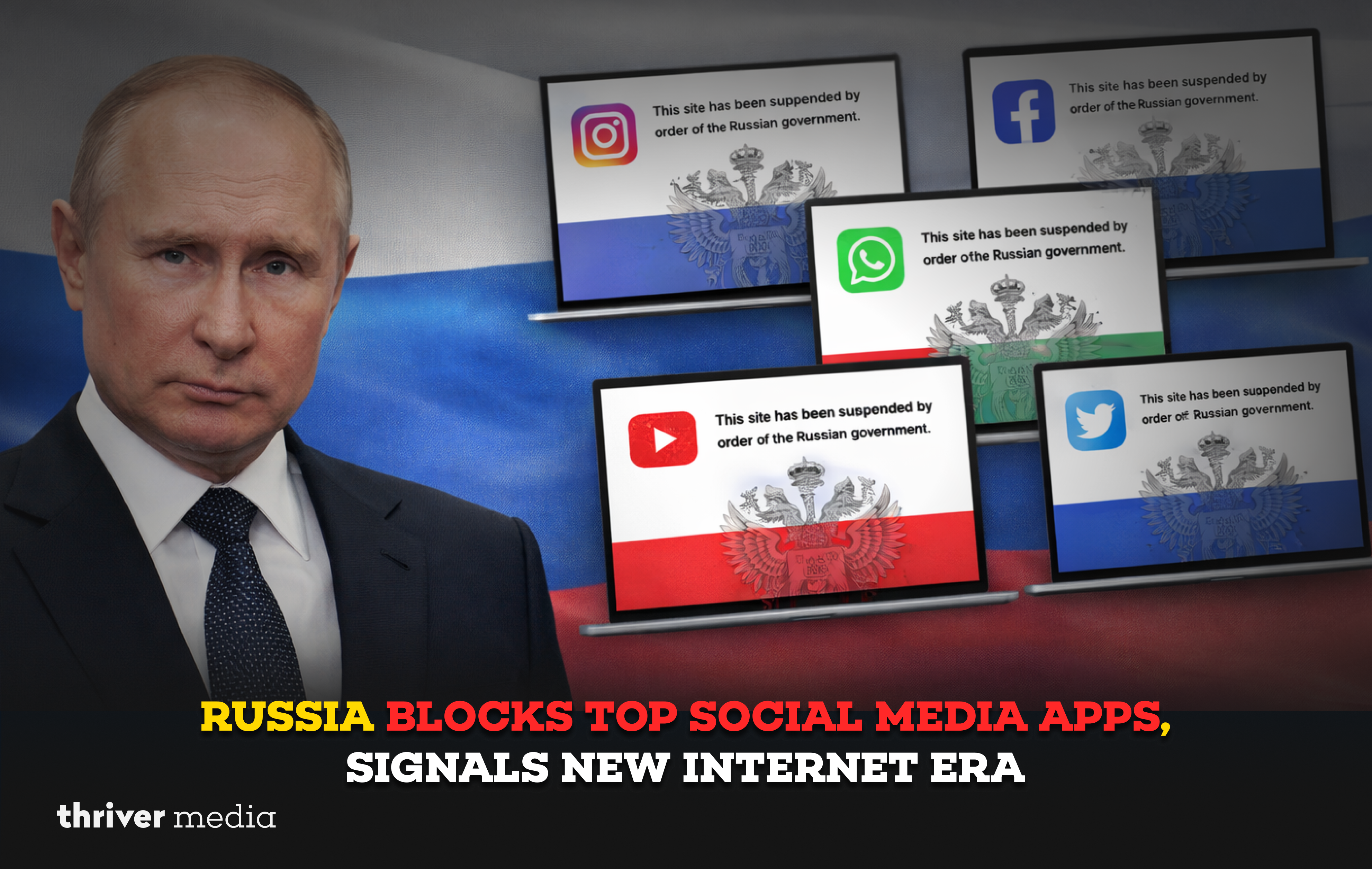
In a decisive move that fundamentally alters how citizens access global digital platforms, Russia blocks social media apps at the ISP level, effectively severing the country from major Western-owned networks. Beginning in March 2022, and continuing with subsequent restrictions, authorities targeted Instagram, Facebook, Twitter, and eventually restricted functionality on WhatsApp and YouTube.
While political headlines focus on censorship, the technical reality is far more significant. This isn’t just about content moderation; it is a structural shift in internet governance. By deploying deep packet inspection (DPI), mandatory data localization, and sovereign DNS infrastructure, Russia is accelerating a global trend toward the “splinternet.” For technologists, this case study reveals how fragile global platform dependency truly is, and how quickly digital ecosystems can be redrawn.
What Happened Platforms Affected
The Russia social media ban initially targeted Meta-owned platforms. Instagram and Facebook were rendered inaccessible via major Russian internet service providers (ISPs) such as Rostelecom and MTS. Shortly after, Twitter was throttled and subsequently blocked, while YouTube experienced severe speed reductions that effectively rendered high-definition streaming impossible.
From an infrastructure standpoint, these blocks are not simple URL blacklists. Russian ISPs, operating under the authority of Roskomnadzor (the federal communications watchdog), implement blocks using TSPU (Technical Means of Countering Threats). This system sits at the gateway level, analyzing packet headers in real-time.
Unlike previous blocks that targeted specific extremist pages, this wave targets entire CDNs and IP ranges. The implication is clear: The Russian internet (Runet) is now operating as a distinct logical partition of the global network, rather than a node within it.
Key Technology Shifts Behind the Ban
To understand why this ban represents a “new era,” we must examine the underlying technology stack enabling it.
ISP Filtering & DNS Manipulation
Russia has spent nearly a decade building infrastructure capable of this scale. The sovereign internet law (2019) mandated that all ISPs install DPI equipment. This allows authorities to inspect traffic regardless of encryption. Even if a user type instagram.com into an HTTPS browser, the SNI (Server Name Indication) field visible during the TLS handshake reveals the destination. Russian DPI boxes read this field and terminate the connection immediately, returning a TCP reset.
Data Sovereignty & Localization
The Russia internet control framework relies heavily on data sovereignty. Legislation requires that Russian user data be stored on servers physically located within the country. For platforms like Facebook and Instagram, compliance meant building expensive local nodes. By forcing this localization, Russia created a kill switch: because the local subsidiaries existed, they could be shuttered instantly, taking the user data and the platform access with them.
Internet Fragmentation (The Splinternet)
We are witnessing the death of the single, unified global internet. The future of the internet censorship is regional. Russia’s stack DPI, sovereign root DNS, and localized data centers creates a blueprint. If a nation controls the directory (DNS) and the pipes (ISPs), it controls the experience. This sets a precedent; the technology required to build a national firewall is no longer exclusive to China. It is now a commercial, off-the-shelf product available to any nation willing to deploy it.
Technical Drawbacks of Russia’s Social Media Ban
While the ban achieves state objectives, it introduces severe technical debt and economic friction for the digital sector.
Impact on Developers and APIs
Thousands of Russian developers relied on the Facebook and Instagram APIs for marketing analytics, CRM integrations, and social login flows. The ban instantly killed these business models. API keys generated in Russia are now largely worthless, as the endpoints are unreachable from domestic IP addresses. This forces developers to either abandon their codebases or engage in complex proxy architectures that violate platform terms of service.
Startup and SaaS Limitations
Russian SaaS companies face an impossible user acquisition funnel. Globally, social media is the primary driver of top-of-funnel traffic. With Instagram and Facebook banned, user acquisition costs for Russian startups targeting domestic users have skyrocketed, pushing them toward less efficient channels like Telegram and native search. For those targeting global markets, the perception of “operating from a blocked jurisdiction” creates trust deficits with international payment processors and cloud providers.
Security and Privacy Risks
Paradoxically, the ban reduces security. Users desperate to access blocked platforms are flooding to unverified VPN services and proxies. These tools often contain malware or sell bandwidth. Furthermore, because the official apps are removed from the Russian App Store and Play Store, users are sideloading outdated APK files containing known vulnerabilities. The ban has created a thriving grey market for software updates, which is inherently insecure.
Potential Tech Advantages
While the drawbacks outweigh the benefits for most technologists, the ban has inadvertently created pressure-testing environments for local alternatives.
Growth of Domestic Platforms
VK (VKontakte) and Odnoklassniki have seen massive infrastructure upgrades. VK has aggressively cloned Instagram features (Clips) and improved its backend to handle increased video traffic. This forced migration proves that in a closed ecosystem, domestic platforms can scale rapidly when foreign competitors are removed.
Decentralized Alternatives
The ban has sparked technical interest in decentralized protocols like ActivityPub (Mastodon) and Matrix. Because these protocols lack a central corporate entity to block, they are harder for Russia to fully eradicate. While Mastodon instances can be blocked individually, the federated nature makes total censorship computationally expensive. We are seeing a migration of technically literate users toward these resilient architectures.
Before vs After Tech Impact Table
| Metric | Before the Ban | After the Ban |
| Platform Access | Direct, low-latency access through local CDN caching | Indirect access via VPNs/proxies; higher latency and degraded quality |
| Data Flow | Bi-directional data exchange; local storage synced globally | Mostly unidirectional; inbound data tightly restricted |
| Developer Reach | Full access to Graph APIs, Marketing APIs, analytics, and SDKs | APIs largely inaccessible; development often requires foreign hosting |
| Innovation Sources | Deep integration with global tech stacks (Meta, Google ecosystems) | Forced pivot to domestic stacks (VK, Yandex, local tools) |
| User Experience | HD video, real-time messaging, smooth uploads and sharing | Buffering, connection timeouts, failed uploads, unstable sessions |
FAQs
Short term yes, but advanced deep packet inspection can identify and throttle VPN traffic, making large-scale use unreliable over time.
SaaS products must adopt region-aware architecture and avoid reliance on single social login or platform-dependent APIs.
Practically, yes, the internet is evolving into multiple sovereign networks rather than one unified global system.
The code remains free, but access to repositories and update channels can be throttled or regionally restricted.
Yes, the technology is proven, and adoption now depends more on political intent than technical limitations.
Bottom Line for Tech Leaders
For founders, CTOs, and digital strategists, the Russia blocks social media apps case is a critical risk assessment template.
First, abandon the assumption of global connectivity. Your cloud architecture must support “regional degradation.” If a user in a specific geography cannot reach your authentication provider or your CDN, can they still access your core product?
Second, treat data localization laws not as compliance checkboxes, but as infrastructure forks. When you store data in a specific country to meet sovereignty rules, you are building a separate instance. You must have a runbook for what happens if that instance is legally severed from your global network.
Third, invest in first-party data infrastructure. The era of relying on Meta and Google for user acquisition in volatile markets is closing. Own your email lists, own your push notification channels, and build community on protocols you control.
Conclusion
The decision by Russia to block top social media apps is not an isolated political event; it is a technical inflection point. We are witnessing the final transition of the internet from a public utility to a series of sovereign enclosures.
By mastering ISP-level filtering, DNS manipulation, and data localization, Russia has demonstrated that the technical architecture for total platform control is mature and scalable. For the global tech community, the message is clear: The open internet is no longer the default. We are entering an era of digital sovereignty, where access is granted or revoked based on geography.
The “splinternet” is here. The question is no longer if it will spread, but when the next major node disconnects.
Source:
🔗 Russia blocks WhatsApp amid wider social media clampdown (based on the CNN report referenced)
This link points to the news coverage that confirms Russia’s ban on WhatsApp alongside broader social media restrictions, which you can cite in your blog.
Disclaimer: The news and information presented on our platform, Thriver Media, are curated from verified and authentic sources, including major news agencies and official channels.
Want more? Subscribe to Thriver Media and never miss a beat.