

28th April 2026

Most websites fail on Google for one simple reason: They write for themselves, not for the person searching.
You might have a beautiful website. Your product might be amazing. But if Google can’t understand you or worse, if Google doesn’t trust you. you’ll stay stuck on page 10. And nobody clicks on page 10.
The good news? Ranking in 2026 isn’t about luck or expensive tricks. It’s about doing a few simple things the right way.
Let me show you exactly how.
What Is SEO, Really? (No Jargon)
SEO stands for Search Engine Optimization. That’s a fancy way of saying: making your website easy for Google to find, read, and recommend.
Think of Google as a librarian. When someone asks a question, the librarian wants to pull out the most helpful, trustworthy book. SEO is how you convince that librarian your “book” deserves the top spot.
In 2026, Google cares about three things:
- Content: Does your page answer the question?
- Intent: Does your page match what the user actually wants?
- Authority: Do other trusted sites vouch for you?
Get these three right, and you’ll rank higher on Google. Ignore any one of them, and you’ll struggle.
Step-by-Step: How to Rank a Website in 2026
Let’s break this down into five simple steps. You don’t need to be a tech genius. You just need to follow the system.
Step 1: Keyword Research (Find What People Actually Search)
Most beginners guess keywords. Don’t guess. Use free tools like Google Autocomplete or AnswerThePublic.
What to do: Type your topic into Google and see what it suggests. For example, type “how to fix…” and see the endings.
Real example: If you sell running shoes, don’t target “best shoes” (too hard). Target “best running shoes for flat feet Pakistan” (easier and more specific).
Step 2: Create Helpful Content (Not Just Long Content)
Forget the old advice about writing 2,000 words just because. In 2026, helpful beats long.
Answer the question fast. Then add more detail. Use short paragraphs, simple words, and examples.
Real example: If someone searches “how to rank a website”, don’t give them a history of Google. Give them a checklist they can use today.
Step 3: On-Page SEO (Help Google Understand You)
This means putting your keyword in the right places. Not stuffing it everywhere. Just the important spots.
Checklist:
- Page title (once, near the beginning)
- One H1 heading (your main title)
- One or two H2 subheadings
- First 100 words of your content
- Image file names (e.g., seo-basics-pakistan.jpg)
Step 4: Technical SEO (Make Your Site Fast & Mobile-Friendly)
Google in 2026 mostly looks at mobile phones. If your site is slow on a phone, you won’t rank.
Quick fixes:
- Compress images (use TinyPNG)
- Use a simple, fast hosting provider
- Make sure buttons are easy to tap on mobile
You don’t need to be a developer. Just run your site through Google’s free “PageSpeed Insights” tool and fix what it flags red.
Step 5: Backlinks (Get Other Sites to Trust You)
Backlinks are like votes of confidence. When a trusted website links to you, Google thinks: “Oh, this site must be good.”
How to get them:
- Write original data or a useful guide (people link to useful things)
- Guest post on relevant blogs
- Get listed in local directories (especially for SEO Pakistan)
Don’t buy backlinks. Google punishes that in 2026 more than ever.
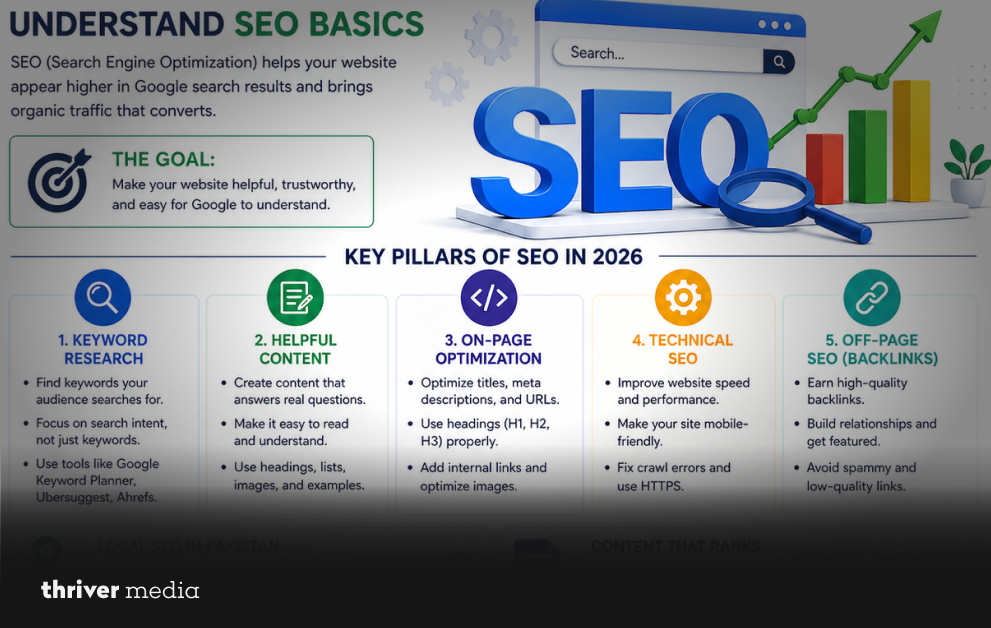
SEO Basics Comparison Table
| SEO Element | What to Do | Why It Matters |
|---|---|---|
| Keywords | Find specific 3-4 word phrases people search | Tells Google what your page is about |
| Content | Answer the question clearly and quickly | Keeps readers happy (Google tracks that) |
| On-Page SEO | Put keywords in title, headings, first 100 words | Helps Google understand your page structure |
| Technical SEO | Make site fast and mobile-friendly | Google prioritizes user experience |
| Backlinks | Get links from trusted local or niche sites | Proves your site is authoritative |
How to Rank a Website (Local SEO Angle)
Ranking in other country is different from ranking in the US or UK. Why? Because Google shows local results first for most searches.
If you run a business, here’s what works in 2026.
1. Google Business Profile (Formerly Google My Business)
This is free and powerful. Fill out every single field. Add photos. Ask customers for reviews.
Real example: Search “best dentist in new york”. The top results aren’t websites. They’re Google Business Profile listings with photos and reviews.
2. Use City + Keyword Phrases
Don’t just target “SEO basics”. Target “SEO basics for small business london” or “how to rank a website in UK”.
Why this works: Low competition, high intent. Someone searching with a city name is ready to buy or visit.
3. Get Local Backlinks
Get mentioned on local news sites, university pages, or business associations in UK. A single link from a .uk domain can help you rank faster than ten random links.
5 Common SEO Mistakes Beginners Make
- Ignoring search intent: Writing about “best running shoes” when the user wanted to buy, not read reviews.
- Keyword stuffing: Repeating “SEO Pakistan” 50 times. Google sees this as spam.
- Slow mobile pages: 2026 is mobile-first. If your mobile site is slow, you won’t rank.
- No internal links: Forgetting to link to your own related pages (this helps Google crawl your site).
- Expecting overnight results: SEO takes 3–6 months. Anyone promising faster is lying.
Best SEO Tools for Beginners
Getting started is easier when you use the right tools. You don’t need everything just a few that actually help you understand what’s working and what’s not.
Google Search Console (Free)
This is your direct line to Google.
- See which queries bring people to your site
- Track clicks, impressions, and rankings
- Submit your sitemap
- Fix indexing and crawl issues
If you only use one tool, start here.
Google Analytics 4 (Free)
This shows what people do after they land on your site.
- Track traffic and user behavior
- Measure session time and engagement
- Monitor conversions
Connect it with Search Console for a clearer picture.
Ubersuggest (Free & Paid)
A simple way to find keyword ideas.
- Discover search volume and competition
- Get content suggestions
- Analyze basic SEO data
Great for beginners who want quick insights without complexity.
Ahrefs (Paid)
A powerful tool used by professionals.
- Deep backlink analysis
- Competitor research
- Keyword tracking
Even the free features can give you useful direction.
Rank Math or Yoast SEO (Free for WordPress)
These plugins guide your on-page setup.
- Optimize titles and meta descriptions
- Improve readability
- Get real-time suggestions while writing
Perfect if you’re using WordPress.
Screaming Frog (Free up to 500 URLs)
Helps you find technical issues fast.
- Detect broken links
- Find duplicate content
- Check missing meta tags
It’s like a quick audit for your site.
FAQs (Short & Sweet)
How long does SEO take to work?
Usually 3 to 6 months for new websites.
Do I need to hire an SEO expert?
Not at first. Learn the SEO basics yourself, then hire for advanced work.
Is SEO still worth it in 2026?
Yes. Over 50% of website traffic still comes from organic search.
Can I rank without backlinks?
For very low competition keywords, yes. For competitive ones, no.
Does Google punish AI content?
Google punishes low-quality content, whether written by AI or humans.
How to Improve Website Ranking: A 90-Day Action Plan
- Month 1: Set up Google Search Console and GA4. Do keyword research. Publish 8-12 optimized articles targeting low-competition keywords.
- Month 2: Build 5 to 10 quality backlinks through guest posting and directory submissions. Improve page speed and fix technical errors found in GSC.
- Month 3: Analyze which pages are getting impressions but not clicks. Improve their meta titles and descriptions. Double down on the content topics that are gaining traction.
The Bottom Line
SEO in 2026 isn’t complicated. And it’s definitely not about tricks.
It comes down to three things:
Create something useful. Make it easy to understand. Build trust over time.
Most businesses miss the first part they don’t actually help the reader. That’s where they lose.
Start simple. Choose one topic. Create a page that genuinely answers a real question. Improve it. Then repeat the process.
Consistency beats intensity.
Small actions, done daily, always win.
How Thriver Helps Businesses Scale (SEO + Ads + Leads)
Here’s the reality that most “SEO experts” won’t tell you:
SEO alone is slow. Paid ads alone are expensive. And lead generation systems alone don’t work without traffic.
That’s where Thriver comes in.
Thriver combines three things that actually work together:
- SEO to get you free, sustainable traffic over time
- Paid ads to get you leads while SEO builds momentum
- Lead generation systems to turn that traffic into paying customers
Instead of guessing which channel works, Thriver builds a complete growth engine. Whether you’re a local business in Pakistan or a brand expanding globally, the approach is the same: test what works, double down, and automate what scales.
No fluff. No long-term contracts just for the sake of it. Just practical systems that grow your revenue.
Conclusion: Your Next Step to Rank Higher on Google
You now understand how modern search works.
You’ve covered keyword research, page optimization, technical improvements, link building, and even how local visibility works in Pakistan.
What’s left now is simple execution.
Pick one page on your site. Improve the title so it’s clearer. Make the page load a bit faster. Add a short section that answers a real question your audience is asking. Then move on to the next page.
Progress beats perfection every time.
If you’d rather not handle everything yourself, having the right team changes the pace. A team like Thriver can take care of SEO, paid campaigns, and lead generation so you can stay focused on growing the business.
Start small. Stay consistent. Rankings follow.
[Contact Thriver today] to discuss your business goals and build systems that actually move the needle.
Want more? Subscribe to Thriver Media and never miss a beat.