
22nd December 2025
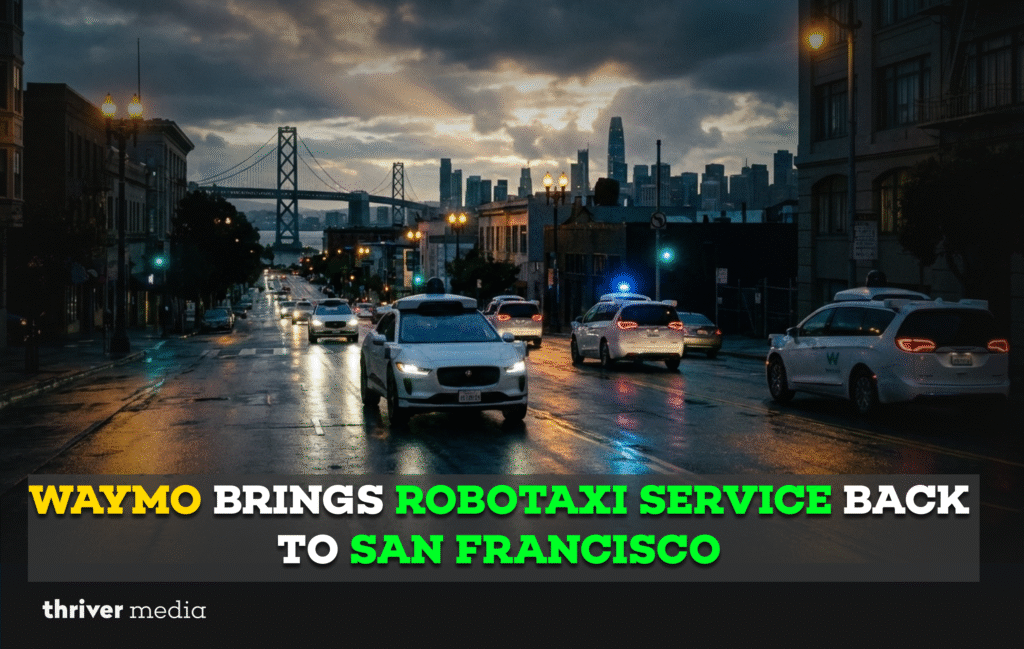
San Francisco’s weekend took an unexpected turn when a massive power outage plunged parts of the city into darkness, creating gridlock and putting the city’s newest transportation service to the ultimate test. For Waymo’s fleet of driverless robotaxis, it was a real-world challenge that went far beyond the usual steep hills and cable cars.
Here’s what happened, how Waymo responded, and what it tells us about the evolving journey of autonomous vehicles.
The Night the Lights Went Out
On Saturday afternoon, a fire at a PG&E substation triggered a cascading power failure. At its peak, around 130,000 customers lost power, with traffic signals going dark across neighborhoods like the Presidio, Richmond District, and downtown.
In the midst of this chaos, social media lit up with videos and reports of multiple Waymo vehicles appearing stalled in the gridlocked streets. Residents reported seeing the iconic Jaguars stopped in traffic, caught in the city-wide snarl.
So, did the robots fail? Not exactly.
How Waymo Handled the Crisis
Waymo’s technology is programmed to treat a non-functioning traffic light as a four-way stop. But this wasn’t one intersection it was a significant portion of the city. Faced with this unprecedented scale, the vehicles’ software became extremely cautious.
As Waymo spokesperson Suzanne Philion explained, “the sheer scale of the outage led to instances where vehicles remained stationary longer than usual to confirm the state of the affected intersections.” In simpler terms, the cars were carefully, and perhaps overly meticulously, trying to navigate a suddenly lawless and unpredictable environment. This extreme caution contributed to the traffic friction.
Crucially, Waymo didn’t wait for a mandate. The company proactively paused its driverless service by Saturday evening, coordinating with city officials. According to the company, the majority of active trips were completed, and vehicles were safely guided back to depots or pulled over.
By Sunday evening, with power being restored and traffic normalizing, the service was quietly resumed.
The Bigger Picture: FAQs from the Blackout
No. There were no reports of accidents caused by the autonomous vehicles. They operated with extreme caution, which in this case, meant contributing to congestion by stopping frequently to assess unsafe intersections.
It was a safety-first, proactive decision. With widespread infrastructure failure, the company decided the most responsible action was to temporarily suspend operations to avoid exacerbating gridlock and to reassess.
Elon Musk tweeted that “Tesla Robotaxis were unaffected.” This is a technicality. Tesla does not operate a commercial driverless robotaxi service in San Francisco or anywhere. Their “Full Self-Driving” system requires an attentive human driver at all times. The comparison is between a supervised driver-assist system and a truly unmanned commercial service.
It proves that real-world deployment involves unpredictable stress tests. A city-wide blackout is a rare, high-consequence event. It highlighted a scenario where the AI’s programmed caution normally a safety asset became a traffic liability.
This event provides invaluable data. Waymo and other AV companies will undoubtedly use it to train their systems for future large-scale infrastructure failures, potentially adjusting how they interpret grid-wide chaos.
The Bottom Line: Progress Isn’t Always a Straight Line
This incident wasn’t a story of failure, but one of responsible stress-testing. It revealed a nuanced truth about this phase of autonomy: the technology isn’t infallible, but its operational framework showed maturity.
Waymo demonstrated a critical non-technological skill: judgment. The decision to pause, coordinate with the city, and resume only when safe is exactly the kind of responsible stewardship the public should expect from companies rolling out such transformative tech.
Conclusion: A Necessary Growing Pain
San Francisco’s blackout weekend served as a sudden, unplanned exam for the city’s robotaxi experiment. While the scorecard shows room for improvement in handling extreme edge cases, it also highlights that the ecosystem the company, the city, the public is learning and adapting in real-time.
The path to integrating autonomous vehicles into our complex cities was never going to be without hiccups. This event was a significant hiccup, but one that provides the crucial data needed to build more robust, resilient, and ultimately safer systems for the future. The service is back on the road, and the engineers now have their most valuable lesson yet: how to navigate when everything goes dark.
Official Source & Further Reading:
For Waymo’s official communications and updates, visit the Waymo Blog.
For details on the PG&E outage and city response, refer to official statements from SF Mayor’s Office and PG&E.
Disclaimer: The news and information presented on our platform, Thriver Media, are curated from verified and authentic sources, including major news agencies and official channels.
Want more? Subscribe to Thriver Media and never miss a beat.