

10th March 2026
How one president’s social media posts crashed oil 10%, triggered stock-market circuit breakers in Seoul, and left global markets asking: does anyone in Washington know what’s happening?
Trump and Iran War Open Summary
In 48 chaotic hours March 9 to 10, 2025 President Donald Trump’s Truth Social posts swung global oil prices by $30 a barrel, triggered automatic trading halts on the South Korean stock exchange, pushed the Federal Reserve’s next rate cut out to July, and left investors worldwide paralyzed between two questions: is the Iran conflict over, or is it about to get catastrophically worse?
The answer, according to Iran’s military, its new Supreme Leader, and every missile still in flight, was the second. But Trump’s words unverified, undefined, and unaccompanied by any diplomatic framework moved markets as if the answer were the first.
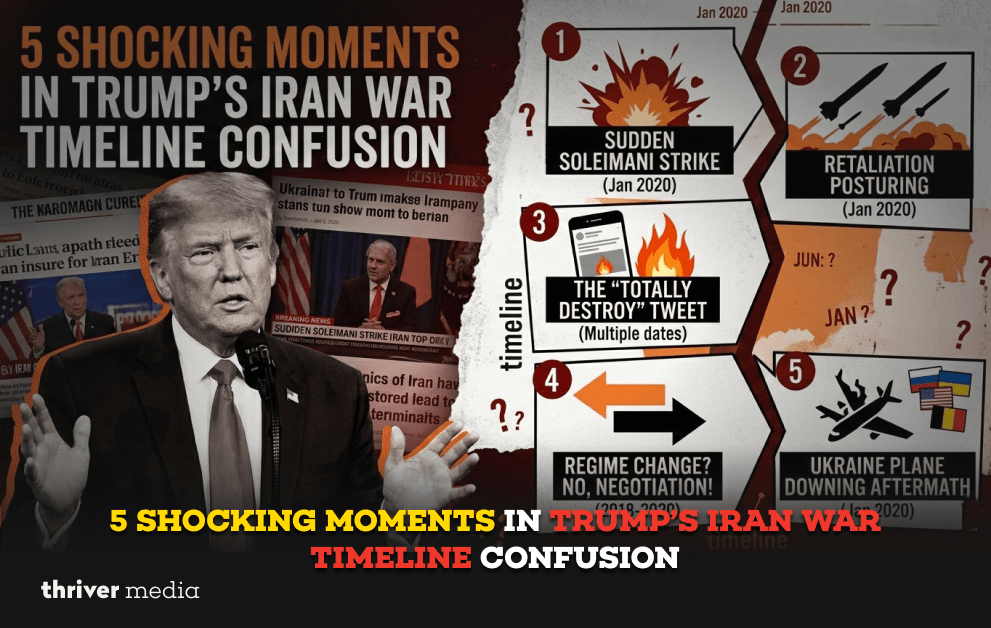
Below are the five most shocking moments from Trump’s Iran war timeline confusion, and exactly why each one matters for markets, investors, and the global economy.
Brent Crude: −10% to $90/bbl | KOSPI: +6.4% (halt triggered) | Nikkei: +3.6% | Gold: $5,133/oz | Fed cut: pushed to July 2025
Market Snapshot: March 10, 2025
Here is a complete at-a-glance breakdown of every major market move driven by Trump’s Iran war statements:
| Asset / Market | Move | Level | Trigger |
| Brent Crude Oil | ▼ −10% | Below $90/bbl | Trump peace post |
| KOSPI (S. Korea) | ▲ +6.4% | Trading halt triggered | Risk-on surge |
| Nikkei 225 (Japan) | ▲ +3.6% | Strong rebound | Investor optimism |
| MSCI Asia-Pac ex-JP | ▲ +2.6% | Partial recovery | Relief rally |
| US 10-Yr Treasury | ▼ −2.3 bps | 4.109% | Inflation fears ease |
| Gold | ▼ −0.1% | $5,133/oz | Stable safe-haven |
Breaking Down the 5 Shocking Moments in Trump’s Iran War Timeline
Shocking Moment #1: Demanding ‘Full Surrender’ While Missiles Were Still Flying
On Monday morning, March 9, Trump posted on Truth Social demanding Iran’s ‘full and complete surrender’ with zero diplomatic groundwork, no back-channel talks, and no verified communication with Tehran. It was a unilateral war objective with no pathway to achievement.
Oil spiked immediately toward $119 per barrel. Wall Street futures sold off sharply. Traders priced in the worst-case scenario: a prolonged military conflict threatening the Strait of Hormuz the chokepoint for 20% of the world’s daily oil supply.
Markets priced in maximum escalation and were caught completely off guard when the tone flipped within hours.
Why it matters: This is one of the most-searched moments of the Iran conflict. Users are asking: ‘Did Trump demand Iran surrender?’ The answer is yes and markets crashed because of it.
Shocking Moment #2: Mission ‘Very Complete’ As Iran Vowed to Escalate
By Monday evening, with no ceasefire signed and no diplomatic contact confirmed, Trump declared the mission ‘very complete.’ The phrase grammatically unusual and strategically undefined instantly became the most-searched phrase in financial news terminals globally.
The cruel irony: at the exact moment Trump posted ‘very complete,’ Iranian military commanders were on national television vowing to increase missile strikes. Two entirely contradictory realities one on Truth Social, one on Iranian state TV. Markets that rallied briefly were exposed to enormous unacknowledged risk.
‘Very complete’ is the most contradicted phrase of 2025 issued while Iran was actively escalating.
Shocking Moment #3: Oil Crashes 10% on a Single Unverified Social Media Post
Tuesday morning delivered the most explosive single-session commodity move of 2025: Brent crude plunged 10% from near $119 to below $90 per barrel in a matter of hours. The catalyst was one Truth Social post in which Trump said the war could be ‘over soon.’
No ceasefire agreement. No verified troop withdrawal. No United Nations resolution. Just words. And yet $30 was stripped from every barrel of oil traded globally before Asian markets finished their morning sessions.
South Korea’s KOSPI surged 6.4% and triggered a sidecar trading curb halting programme trading for five minutes after futures rose more than 5%. Japan’s Nikkei 225 jumped 3.6%. The MSCI Asia-Pacific ex-Japan index gained 2.6%.
A single unverified social media post moved a multi-trillion-dollar commodity market by 10% in hours. That is the defining market dynamic of 2025.
Shocking Moment #4: Iran’s New Supreme Leader Defied Trump And Markets Ignored It
While global equities celebrated, a seismic political event was unfolding in Tehran that most Western financial analysts had barely registered: hardliners publicly rallied behind newly installed Supreme Leader Mojtaba Khamenei in a pointed, theatrical display of defiance his first major public act as Iran’s new supreme leader.
This is the shocking structural reality that Tuesday’s rally failed to price: a new Supreme Leader installed during an active war with the United States has a political incentive to demonstrate strength, not offer concessions. Trump’s public demands for ‘full surrender’ made a private diplomatic resolution structurally harder, not easier.
The geopolitical risk premium was not eliminated on March 10. It was merely temporarily suppressed and investors who ignored this context bought into a fundamentally fragile rally.
A new wartime Supreme Leader cannot afford to look weak making Trump’s surrender demands counterproductive to any real peace.
Shocking Moment #5: Peace Signal and ’20X Harder’ Threat Issued Within 12 Hours
The fifth and most stunning contradiction: within the same 12-hour window on Tuesday, Trump both signaled peace and issued one of the most explicit military threats made by a sitting U.S. president in recent memory.
In the morning, he said the war could be ‘over soon’ sending Asian markets soaring. By afternoon, he posted on Truth Social that if Iran took any action to stop oil flowing through the Strait of Hormuz, the United States would retaliate ‘TWENTY TIMES HARDER than they have been hit thus far.’
A peace signal and a ’20x harder’ military threat. In the same 12 hours. From the same account. These two statements are logically and strategically irreconcilable yet both moved global markets in real time.
The Strait of Hormuz carries 20% of global daily oil supply. One Iranian provocation could reverse every market gain from Tuesday within a single trading session.
Frequently Asked Questions
These are the top questions people are searching about Trump’s Iran war statements and their impact on global markets answered directly for featured snippet and People Also Ask optimization:
Did Trump confirm a ceasefire with Iran?
No. Trump posted optimistic language on Truth Social, but no signed agreement, ceasefire document, or formal diplomatic framework was announced.
Why did oil prices crash 10% in one day?
Markets priced out the war risk premium after Trump said the conflict could be ‘over soon.’ Brent crude fell from ~$119 to below $90/barrel on a single unverified post.
Is the Strait of Hormuz still at risk?
Yes. Iran’s military has not stood down, and Trump threatened to retaliate ’20 times harder’ if Hormuz is blocked. The risk remains active.
How did Asian stock markets react to Trump’s Iran comments?
South Korea’s KOSPI surged 6.4% triggering an automatic trading halt. Japan’s Nikkei rose 3.6%. MSCI Asia-Pacific gained 2.6%.
When will the Federal Reserve cut interest rates?
Rate-cut expectations have been pushed to July 2025, per CME FedWatch, after the oil price spike briefly raised inflation concerns.
What does ‘very complete’ mean Trump’s Iran phrase?
Trump declared the mission ‘very complete’ without defining it. No ceasefire, no withdrawal of forces, and no diplomatic explanation followed the phrase.
Bottom Line
Trump’s words moved global markets more than Iran’s missiles did and that is the most alarming financial reality of 2025.
The rally in Asian equities is real. The crash in oil is real. But neither reflects a genuine resolution of the Iran conflict. Iran’s military has not stood down. The new Supreme Leader has political incentives to escalate. And the Strait of Hormuz through which 20% of global daily oil supply flows remains one miscalculation away from a full market reversal.
Until a signed, verified ceasefire exists, every Trump social media post is a volatility event disguised as policy. The five moments above are not anomalies. They are the new architecture of geopolitical market risk and investors who treat presidential social media posts as actionable diplomatic signals are taking on risks they cannot yet see.
Conclusion
These five shocking moments in Trump’s Iran war timeline confusion reveal something bigger than one conflict, one president, or one volatile trading week. They expose a structural vulnerability in modern markets: that a single unverified social media post from one individual can now crash commodities, trigger circuit breakers in multiple countries, reset central bank rate-cut expectations, and reshaping trillions of dollars in asset valuations all within hours.
The world is watching the Strait of Hormuz. Investors are watching Trump’s phone. Iran is watching for signs of weakness. In that environment, the only certainty is continued volatility and the investors who navigate it best will be those who distinguish between a social media declaration and a verified diplomatic development, between noise and signal, between hope and fact.
Watch the Strait of Hormuz. Watch Iran’s military posture. And the next time Trump declares a war ‘very complete’ check whether the missiles have actually stopped flying before you trade on it.
Disclaimer: The news and information presented on our platform, Thriver Media, are curated from verified and authentic sources, including major news agencies and official channels.
Want more? Subscribe to Thriver Media and never miss a beat.