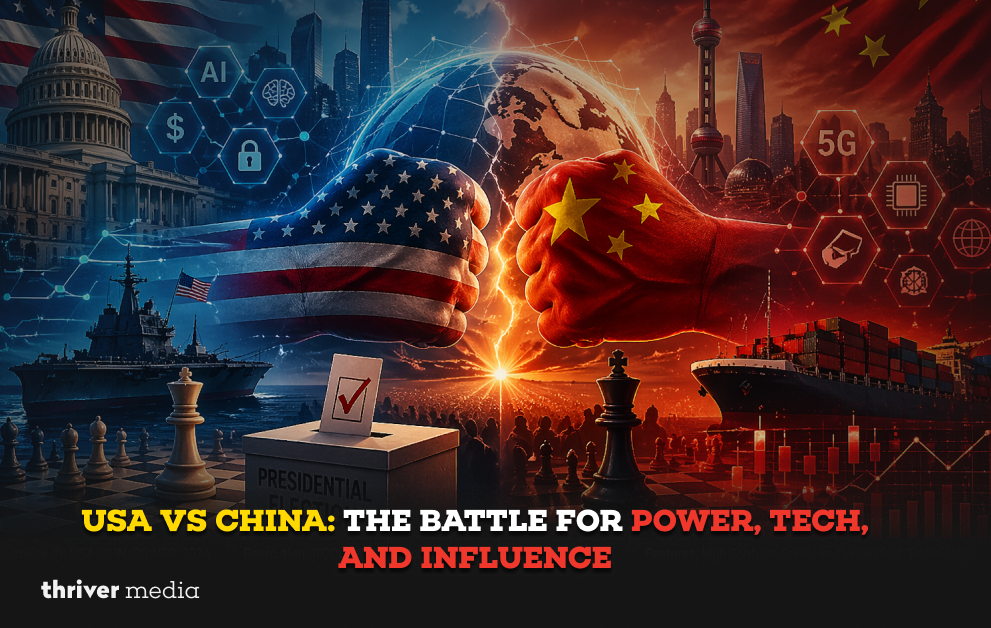
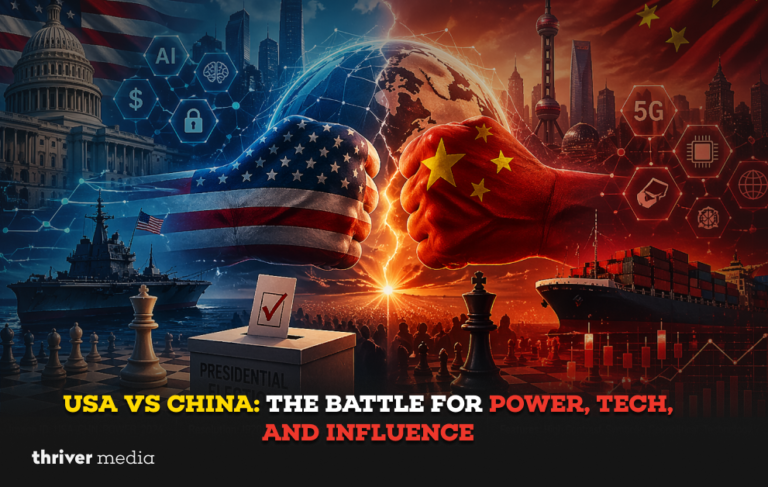
This isn’t new it’s just evolving. The players change. The game doesn’t.
Somewhere between the headlines and the trade negotiations, between the semiconductor supply chains and the satellite launches, a rivalry is unfolding that will define the trajectory of the 21st century. It’s not a cold war not exactly. And it’s not a partnership not anymore. It’s something that doesn’t have a clean label, which is precisely what makes it so important to understand.
The USA vs China competition is the single most consequential geopolitical dynamic on the planet right now. It touches everything: the phone in your pocket, the cost of the goods you buy, the career opportunities available to your children, the alliances your country chooses, and the rules that govern the global economy. Whether you’re a student in Lahore, a startup founder in Berlin, or a factory worker in Ohio, this rivalry reaches you. It just doesn’t always announce itself.
This article is a deep dive into that rivalry. Not a news report those go stale within a week. This is an analysis of the patterns, the systems, and the long-term forces driving the most important power competition of our time. The goal is to help you understand not just what is happening, but why it keeps happening, and what it means for the future.
USA Vs China Back History: Origins of the Rivalry
The American Century
After World War II, the United States built the architecture of the modern world. The dollar became the global reserve currency. American military bases spread across continents. Institutions like the United Nations, the World Bank, and the International Monetary Fund were designed largely around American interests and values. NATO unified the Western bloc. Hollywood exported American culture to every corner of the globe.
For nearly half a century, the primary challenge to this order came from the Soviet Union. When the USSR collapsed in 1991, the United States stood alone as the world’s undisputed superpower. Economists called it the unipolar moment. Military analysts called it the end of history. Business leaders called it the age of globalization. And for about two decades, that assessment was largely correct.
China’s Quiet Rise
While the world was focused on the Cold War and then on the war on terror, China was doing something remarkable. Beginning with Deng Xiaoping’s economic reforms in 1978, China opened itself to market forces while maintaining centralized political control. It was a model that didn’t fit neatly into Western categories neither fully capitalist nor fully communist but it worked at an extraordinary scale.
Within a single generation, hundreds of millions of Chinese citizens moved out of poverty. Manufacturing surged. Export volumes exploded. Infrastructure projects highways, high-speed rail networks, entire new cities went up at a pace the world had never seen. By the early 2000s, China had become the factory floor of the global economy, producing everything from consumer electronics to industrial machinery at costs no other nation could match.
For a long time, the prevailing belief in Washington and across Western capitals was that economic openness would inevitably lead to political liberalization in China. The theory was simple: as the Chinese middle class grew, it would demand democratic reforms. Trade with China would bring China into the liberal world order. That theory turned out to be wrong.
From Cooperation to Competition
The shift from strategic partners to strategic competitors didn’t happen overnight. It accumulated. China joined the World Trade Organization in 2001, and trade between the two nations boomed. But alongside that trade came growing tensions: intellectual property disputes, currency manipulation accusations, military modernization in the South China Sea, and increasing evidence that the Chinese Communist Party had no intention of liberalizing politically.
By the 2010s, the relationship had fundamentally changed. China was no longer a developing country gratefully accepting foreign investment. It was a global power with its own ambitions, its own technology sector, its own military capabilities, and its own vision for how the world should be organized. The era of cooperation was over. The era of systemic competition had begun.
The Big Idea: A System-Level Rivalry
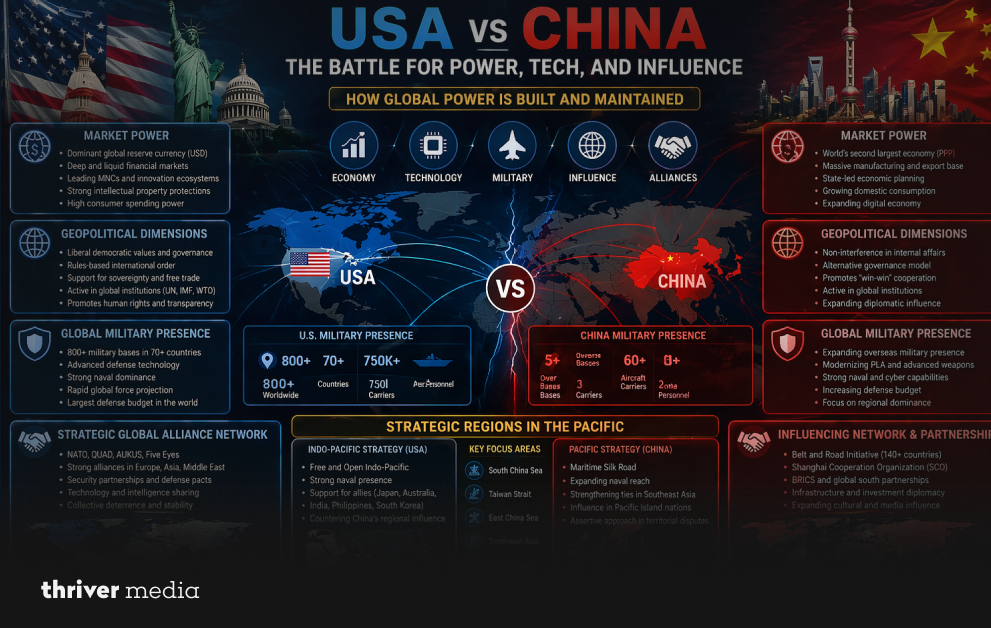
USA vs China global power comparison highlighting economy, technology, military strength, and influence across regions
Here’s the concept that most casual observers miss: USA vs China is not a temporary disagreement that diplomacy can resolve. It’s not about one trade deal, one tariff, or one election cycle. It’s a structural, system-level competition between two fundamentally different models of governance, economic organization, and global leadership.
The United States represents a model built on liberal democracy, free markets (with regulation), individual rights, and a rules-based international order. China represents a model built on centralized governance, state-directed capitalism, collective stability over individual freedom, and an alternative vision of international relations where sovereignty trumps intervention.
These aren’t positions either side adopted recently. They’re deeply embedded in each nation’s history, culture, institutions, and self-identity. Which means this rivalry isn’t going away regardless of who occupies the White House or Zhongnanhai. The specifics will shift. The underlying competition will not.
Understanding this is critical because it changes how you interpret every data point. A tariff isn’t just a tariff. A chip export restriction isn’t just about semiconductors. A military exercise isn’t just posturing. Each is a move in a much larger, multi-decade game that both sides are playing with existential seriousness.
Power: The Geopolitical Dimension
Military Reach and Strategic Posture
The United States maintains the largest and most globally deployed military in history. With over 750 overseas bases, carrier strike groups patrolling every ocean, and the most advanced weapons systems on the planet, American military power is unmatched in its reach. The U.S. defense budget alone dwarfs the next several countries combined.
China’s military, the People’s Liberation Army, has undergone a stunning modernization program over the past two decades. Its navy has grown to become the largest in the world by number of vessels. Its missile technology, particularly anti-ship ballistic missiles, is designed specifically to counter U.S. carrier groups in the Pacific. Its space and cyber capabilities have expanded rapidly. China may not yet match the U.S. in global power projection, but within its own region the Indo-Pacific it has become a formidable and, in some scenarios, dominant force.
Alliances and Partnerships
America’s greatest strategic asset isn’t its military hardware. It’s its alliance network. NATO, the Five Eyes intelligence partnership, bilateral security agreements with Japan, South Korea, Australia, and the Philippines these relationships give the U.S. a strategic presence and information advantage that no single nation can replicate.
China’s approach is different. Rather than building formal military alliances, Beijing has invested in economic partnerships and strategic dependencies. The Belt and Road Initiative, now spanning over 140 countries, creates infrastructure and trade links that give China significant leverage without the political obligations of traditional alliances. Organizations like the Shanghai Cooperation Organisation provide loose security coordination. The BRICS grouping positions China within a rising bloc that challenges Western-dominated institutions.
The Taiwan Question
If there is one geographic flashpoint that could transform this rivalry from strategic competition into direct conflict, it’s Taiwan. The self-governing island sits at the intersection of every major tension in the U.S.–China relationship: sovereignty, military power, semiconductor supply chains (Taiwan produces the majority of the world’s most advanced chips), and international credibility.
China considers Taiwan a breakaway province to be reunified, by force if necessary. The U.S. maintains a policy of strategic ambiguity officially acknowledging China’s position while simultaneously arming Taiwan and implying it would intervene in a military conflict. This ambiguity has kept the peace for decades, but as China’s military capability grows and nationalist sentiment intensifies, the stability of this arrangement is increasingly tested.
Technology: Control of the Future
The Semiconductor Battlefield
If you want to understand the USA vs China technology race in one word, that word is semiconductors. These tiny chips power everything from smartphones and electric vehicles to artificial intelligence systems and military guidance equipment. Whoever controls the semiconductor supply chain controls the technological future.
The United States and its allies particularly the Netherlands (ASML), Japan, South Korea, and Taiwan (TSMC) currently dominate the most advanced chipmaking processes. Washington has moved aggressively to restrict China’s access to cutting-edge chip technology, implementing export controls that represent some of the most significant economic restrictions imposed on a major power in peacetime.
China, in response, has poured hundreds of billions of dollars into building its own domestic semiconductor capability. Progress has been real but uneven. Advanced chip fabrication requires not just money but decades of accumulated expertise, precision manufacturing equipment, and deep supplier ecosystems. China has closed significant gaps, but the most cutting-edge processes remain out of reach for now.
Artificial Intelligence: The Defining Race
Both nations recognize that artificial intelligence will be the most transformative technology of the coming decades, with implications for economic productivity, military capability, scientific research, and social governance. This understanding has turned AI into the central front of the technology race.
The U.S. leads in foundational AI research, driven by companies like Google, Microsoft, Meta, and a thriving startup ecosystem. American universities attract top AI talent from around the world. The open research culture in the U.S. has produced many of the breakthroughs that define modern AI.
China’s strengths lie in scale and application. With a massive domestic market, fewer data privacy constraints, and a government willing to deploy AI across surveillance, manufacturing, and public services, China has built formidable AI capabilities focused on real-world implementation. Its leading tech companies Baidu, Alibaba, Tencent, ByteDance, and newer players like DeepSeek are not second-tier. They are globally competitive.
Data, 5G, and Digital Infrastructure
Beyond chips and AI, the technology race extends to who controls the digital infrastructure of the future. Huawei’s 5G technology is deployed across large parts of the developing world, creating digital networks that run on Chinese-built systems. The U.S. has pushed allies to ban Huawei equipment, citing security concerns, but the reality is that many countries have chosen based on cost and availability rather than geopolitics.
Data is the other critical dimension. How data flows where it’s stored, who can access it, what rules govern it—is a question that will define both the technology race and the governance models that compete for global adoption. The U.S. favors relatively open data flows (with growing regulation). China favors data sovereignty and state oversight. Much of the world hasn’t decided yet, and both sides are working to influence that decision.
Influence: Economic and Cultural Power
Trade Networks and Market Power
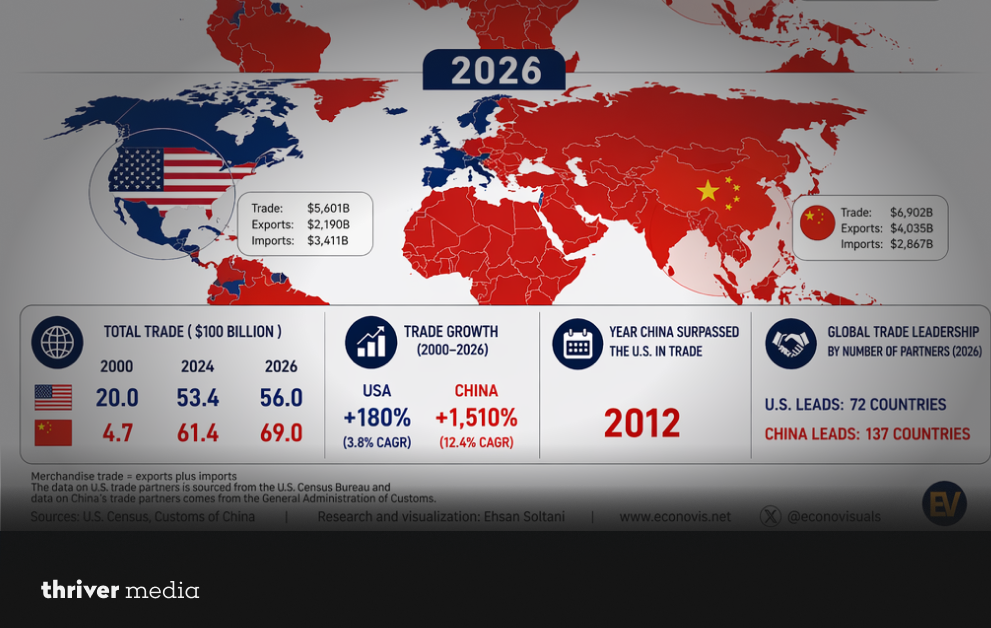
China is now the largest trading partner for more countries than the United States. That’s a statistic worth sitting with. For decades, being America’s trading partner was essentially a requirement for integration into the global economy. That’s no longer the case. China’s manufacturing base, its appetite for raw materials, and its willingness to invest in developing economies have shifted trade gravity eastward.
The U.S. retains enormous market power the American consumer market remains the most valuable in the world, and the dollar’s role as the global reserve currency gives Washington extraordinary financial leverage. Sanctions, dollar-denominated debt, and access to the SWIFT banking system are tools of influence no other country can wield as effectively.
But China is working to reduce its vulnerability to these tools. Bilateral trade agreements denominated in yuan, alternative payment systems, and institutions like the Asian Infrastructure Investment Bank are all part of a long-term effort to build an economic architecture that doesn’t depend on American goodwill.
Soft Power and Cultural Reach
The United States still dominates global soft power through Hollywood, Silicon Valley, American universities, and a cultural influence that has permeated everything from fashion to music to business philosophy. English remains the global language of commerce and technology.
China’s soft power approach is different. It emphasizes infrastructure over entertainment, practical development over cultural aspiration. Confucius Institutes spread language and cultural education. Chinese-built ports, railways, and power plants across Africa, Southeast Asia, and Latin America create goodwill and dependency simultaneously. TikTok, perhaps the most globally influential app of the past decade, is Chinese-owned—proof that cultural influence can travel in unexpected packaging.
The Battle for Narrative
Influence is ultimately about narrative: who gets to define what progress looks like, what a successful society is, and what the rules of global engagement should be. The U.S. narrative emphasizes freedom, innovation, and individual rights. China’s narrative emphasizes stability, development, and collective prosperity. Both have genuine achievements to point to. Both have genuine contradictions to explain. The world is watching both, and increasingly, picking elements from each rather than choosing one wholesale.
The Pattern: Competition, Tension, Adaptation
2026 global trade map shows China expanding its dominance while the U.S. maintains strong but reduced global reach
Step back from the specifics and a clear pattern emerges. Great power rivalries follow a familiar rhythm: competition creates tension, tension drives adaptation, and adaptation resets the terms starting the cycle again.
History repeats this structure. Britain and France competed for centuries over empire and influence. Britain and Germany clashed over industrial strength and naval power. The United States and the Soviet Union competed across ideology, military capability, and global reach. In each case, the rivalry didn’t resolve it evolved. The arenas changed, from territory to technology to economics, but the underlying dynamic stayed the same.
The U.S. China rivalry fits this pattern. What began as trade competition expanded into technology and now spans military positioning, institutional influence, and competing visions of global order. When one side adapts restricting access to advanced chips the other responds by accelerating domestic production. The contest doesn’t end; it shifts.
That’s the point most people miss.
Recognizing this pattern helps avoid two common mistakes: assuming the rivalry will fade on its own, or assuming it will inevitably spiral into conflict. History suggests something more complex an ongoing, managed competition that intensifies and eases over time, shaped by policy decisions, public pressure, and events no one fully predicts.
Current Situation: The Modern Phase
Economic Decoupling
For decades, the global economy was built on integration factories in Shenzhen supplying consumers in Seattle, all connected through deeply interdependent supply chains. That model isn’t disappearing, but it is being reshaped.
Not because globalization failed, but because both sides now see risk where they once saw efficiency.
The U.S. has moved to reduce reliance on Chinese manufacturing in critical areas semiconductors, pharmaceuticals, rare earths, and defense components. Terms like “friend-shoring” and “near-shoring” aren’t just policy language anymore; they’re active strategies, pushing production toward allied countries or closer to home.
China, on the other hand, is adapting in its own way. Its “dual circulation” strategy focuses on strengthening domestic demand while maintaining external trade an attempt to reduce exposure to Western markets without fully stepping away from them.
A full economic split isn’t realistic. The systems are too deeply connected.
But that’s not what’s happening.
What’s unfolding is more targeted and more significant: a selective separation in sectors that matter most.
And once that process starts, it rarely reverses.
Tech Restrictions and Innovation Arms Race
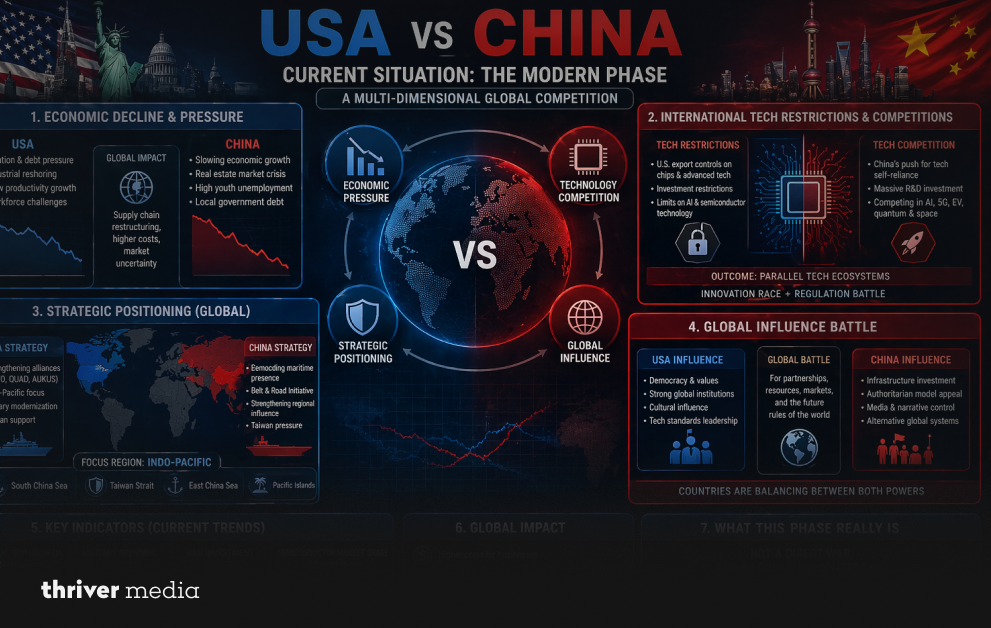
Technology restrictions have become the most visible tool in this rivalry’s modern phase. U.S. export controls on advanced chips and chipmaking equipment, restrictions on Chinese tech companies operating in Western markets, and investment screening for Chinese-linked firms represent a deliberate strategy to maintain technological advantage.
China’s response has been to invest unprecedented resources into domestic innovation. National funds for semiconductor development, aggressive AI research programs, and a whole-of-government approach to technological self-sufficiency are reshaping China’s innovation ecosystem. The results are mixed but the trajectory is clear: China intends to build capabilities that no embargo can take away.
Strategic Positioning
Globally, both powers are working to secure alliances and partnerships that strengthen their position. The U.S. has deepened relationships with Indo-Pacific allies, launched frameworks like AUKUS (with Australia and the UK), and reinvested in NATO. China has expanded BRICS, deepened ties with Russia, increased engagement across the Global South, and positioned itself as an alternative partner for nations uncomfortable with Western conditions on aid and trade.
The result is a world that isn’t cleanly divided into two blocs most countries are trying to maintain relationships with both sides but is increasingly shaped by the gravitational pull of this rivalry.
People’s Reactions: Public and Global Perspective
Inside the United States
American public opinion on China has shifted dramatically over the past decade. Polling consistently shows that a majority of Americans now view China as a competitor or adversary rather than a partner. This shift crosses party lines, though the specific concerns differ economic competition, human rights issues, and security threats are all cited. The political consensus in Washington that China represents a strategic challenge is one of the few bipartisan agreements that has held steady.
Inside China
Chinese public sentiment is shaped by a national narrative that emphasizes the country’s remarkable rise and the obstacles placed in its path by Western powers. Many Chinese citizens view U.S. restrictions on technology and trade as attempts to contain China’s legitimate development. Nationalist sentiment is strong, particularly among younger demographics who have grown up during China’s period of greatest prosperity and global influence.
The Global Audience
For the rest of the world, this rivalry is both an opportunity and a source of anxiety. Developing nations can leverage competition between the two powers to negotiate better terms on trade, investment, and infrastructure. But they also face pressure to choose sides on issues like technology standards, security partnerships, and diplomatic votes.
Business communities globally are caught in a difficult position: wanting access to both the world’s largest consumer market (China) and the world’s most valuable one (the U.S.), while navigating regulatory environments that increasingly penalize fence-sitting. Social media amplifies both sides’ narratives, creating information environments where perceptions of the rivalry vary wildly depending on which platforms and sources people consume.
Why It Affects Everyone
USA vs China rivalry enters a modern phase defined by economic pressure, technology restrictions, and global influence competition
Jobs and Industries
The decisions made in this rivalry ripple through labor markets worldwide. When a factory moves from Guangdong to Vietnam because of trade tensions, that creates jobs in one country and eliminates them in another. When chip restrictions slow down Chinese tech companies, the contractors and suppliers who served those companies feel the impact regardless of nationality. The industries that will define the next economy AI, clean energy, biotechnology, space are all deeply influenced by how this competition plays out.
Cost of Living
Tariffs and trade restrictions have direct effects on consumer prices. When goods that were manufactured cheaply in China become subject to import duties, the cost gets passed to consumers. When supply chains are restructured for strategic rather than economic reasons, efficiency decreases and prices rise. The inflationary pressure from great power competition is real, even if it’s rarely discussed in those terms.
Access to Technology
Which phone you use, which apps are available, which AI tools you can access, and which digital infrastructure powers your internet all of these are increasingly influenced by the technology race between the USA and China. If the global technology ecosystem splits into two competing standards, billions of people will live in one digital world or the other, with consequences for innovation, connectivity, and economic opportunity.
Business and Career Opportunities
For professionals, entrepreneurs, and students, understanding this rivalry is a career-critical skill. Industries are restructuring. Supply chains are redirecting. Investment patterns are shifting. The professionals who understand these dynamics will navigate them successfully. The ones who don’t will be caught off guard by changes they didn’t see coming.
Future Outlook: Possible Directions
Predicting exactly how this rivalry resolves is a fool’s errand. But we can map the plausible scenarios and understand the forces that push toward each.
Scenario One: Shared Global Dominance
In this scenario, both nations eventually accept that neither can achieve unilateral dominance. They settle into a managed competition where certain areas climate change, pandemic response, space governance see cooperation, while others technology, military posture, economic systems remain competitive. The world operates under two overlapping spheres of influence, with most countries maintaining productive relationships with both. This requires mature diplomacy, functioning communication channels, and a shared interest in avoiding catastrophe.
Scenario Two: A Divided World System
Here, decoupling deepens until the global economy splits into two largely separate ecosystems. One sphere centered on the U.S. and its allies, operating under one set of technology standards, trade rules, and governance norms. Another sphere centered on China and its partners, operating under a different set. Countries in between are forced to choose, or they develop the capacity to operate in both systems simultaneously at significant cost. This is the scenario that most alarms economists, because a divided world is a less efficient and more fragile world.
Scenario Three: One Dominant Power
In this scenario, one side gains a decisive advantage likely through a technological breakthrough, an internal crisis in the other, or a geopolitical event that shifts the balance permanently. This is the least likely scenario in the near term, because both nations are large, resilient, and deeply motivated. But over longer time horizons, internal pressures demographic challenges, economic imbalances, political instability could weaken one side enough to shift the equilibrium.
The most honest assessment is that the future will likely contain elements of all three scenarios, shifting between them depending on specific issues, specific leaders, and specific events. The rivalry isn’t heading toward a single conclusion. It’s heading toward an ongoing, evolving, multi-dimensional competition that will be the backdrop for global politics, economics, and technology for decades.
Frequently Asked Questions
What is the USA vs China rivalry about?
It’s a system-level competition over global power, technological leadership, economic influence, and the rules that govern the international order.
Why is this rivalry important globally?
It shapes trade, technology standards, military alliances, and economic opportunities for every nation and individual on the planet.
Who is leading in technology?
The U.S. leads in foundational research and cutting-edge semiconductors; China leads in scaled AI applications and manufacturing integration.
Will this rivalry turn into conflict?
Direct military conflict is possible but not inevitable the most likely path is managed competition with periods of escalation and de-escalation.
How does it affect everyday people?
Through job availability, consumer prices, technology access, investment opportunities, and the geopolitical stability of the world they live in.
The Bottom Line
The USA–China rivalry isn’t a phase. It’s the defining geopolitical force of the 21st century a long-term competition shaped by fundamentally different systems of power, economics, and global ambition.
It’s already reshaping supply chains, redrawing alliances, and redefining who leads in technology. The effects aren’t abstract. They’re showing up in markets, industries, and everyday decisions quietly but consistently.
This isn’t something that fades. The details will evolve, but the core dynamic will remain.
And that’s the part most people miss.
Understanding this shift isn’t optional anymore not if you care about where opportunities move, how industries change, or what the next decade looks like.
Those who see the pattern early can position themselves. Those who don’t… will still be affected just without knowing why.
Conclusion: The Rivalry That Defines Our Time
History doesn’t repeat, but it does rhyme. The competition between the United States and China echoes every great power rivalry that has come before but with a twist. This time, the battlefields are digital as well as physical. The weapons are algorithms as well as aircraft carriers. The stakes involve not just territory but the architecture of the global information ecosystem itself.
Neither side chose this rivalry both arrived at it through decades of growth, ambition, and strategic calculation. And neither side can exit it unilaterally, because the competition is embedded in their structures, not just their policies.
For the rest of the world, the path forward requires clear-eyed realism. Not fear. Not blind alignment with either side. But a genuine understanding of the forces at play, the patterns they follow, and the choices they present. The USA vs China rivalry is not something happening to other people in distant capitals. It is happening to all of us, in the prices we pay, the technologies we use, the opportunities we pursue, and the world our children will inherit.
Pay attention. This isn’t going away. And understanding it might be the most important strategic investment you make.
The game continues. The question is whether you’re watching the board.
Disclaimer: The news and information presented on our platform, Thriver Media, are curated from verified and authentic sources, including major news agencies and official channels.
Want more? Subscribe to Thriver Media and never miss a beat.