
20th April 2026
A $400 million ballroom at the White House. Corinthian columns. Gilded interiors. A triumphal arch near the Lincoln Memorial with golden eagles perched on top.
This isn’t a scene from a period drama about European royalty. This is the current presidency.
And whether you think it’s bold leadership or tone-deaf excess, one thing is clear it’s not accidental. Every rendering, every unveiling, every image held up for cameras is a calculated move. The question worth asking: what exactly is being built here? A room or a message?
Trump Ballroom Isn’t Just a Building
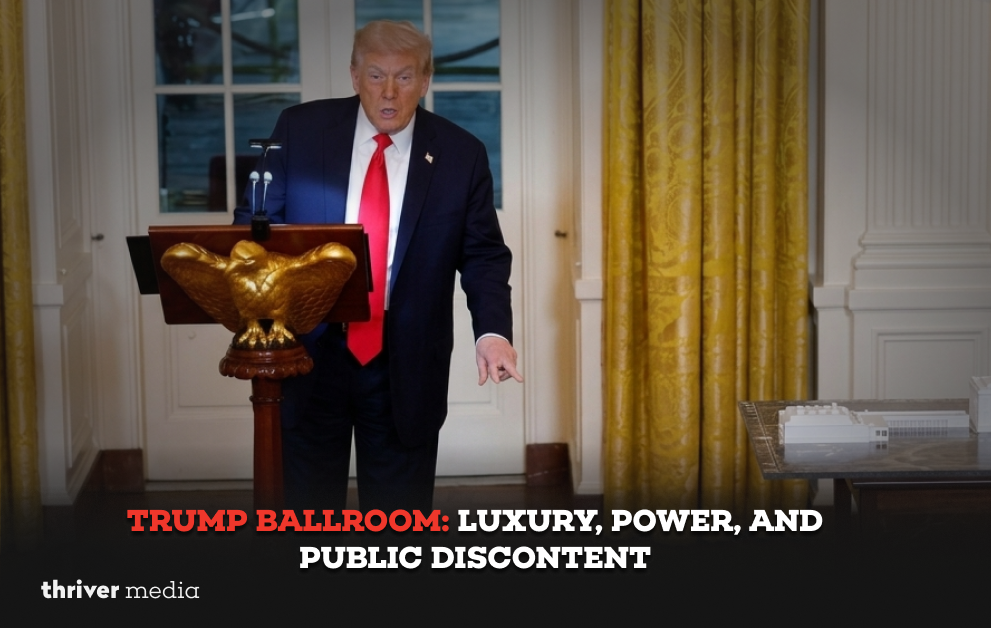
When Donald Trump held up architectural renderings aboard Air Force One in late March 2026, he wasn’t just showing off floor plans. He was staging a moment. The setting mattered. The audience mattered. The image of a president personally curating his own monument that mattered most of all.
The Washington Post framed the ballroom project as something deeper than construction. Their coverage positioned the $400 million East Wing replacement as a deliberate exercise in visual authority a presidency communicated through rooms, objects, and settings rather than just legislation and speeches. The renderings weren’t informational. They were performative.
Days later, White House press secretary Karoline Leavitt reinforced the narrative by holding up an artist rendering of a proposed 250-foot triumphal arch during a briefing in the James Brady Press Briefing Room. The staging was deliberate. The press room became a gallery. The government became a showroom.
Together, these moments reveal a pattern. The administration isn’t presenting architecture. It’s presenting an aesthetic of power.
Gold and What It Signals
Gold has always carried weight in the language of power. Thrones, crowns, palaces the color doesn’t whisper. It announces.
Trump has long favored gold aesthetics in his personal brand. Mar-a-Lago. Trump Tower. The penthouse. But applying that same visual language to the White House changes the conversation entirely. A private citizen who likes gold is eccentric. A president who insists on it is making a statement about the office itself.
The proposed ballroom interior with ornate chandeliers, neoclassical detailing, and a capacity expanded from 650 to 999 reads less like a functional event space and more like a declaration: this presidency is meant to be felt, not just observed.
Critics have called it imperial. Architects who submitted public comments to the National Capital Planning Commission used words like “gaudy,” “out of scale,” and “un-American in style.” One architect noted the interiors were more fitting for a medieval European king than an American president. Another called it something better suited to a second-rate Las Vegas hotel.
Supporters see something different a restoration of grandeur, a president unafraid to build boldly on behalf of the nation.
The same image. Two completely different readings. That’s the tension at the heart of this entire project.
The Marie Antoinette Problem
The comparisons have arrived, and they’re not subtle.
When a president prioritizes a $400 million ballroom while a partial government shutdown drags on and military conflicts continue abroad, the optics write themselves. The Associated Press reported that Trump discussed ballroom plans extensively aboard Air Force One, noting he was “fighting wars and other things” then spent the next several minutes detailing Corinthian column choices.
That contrast has given critics a powerful frame: Marie Antoinette. Not the historical figure specifically, but the archetype a leader so absorbed in luxury that they lose sight of what ordinary people are dealing with.
An ABC News/Washington Post/Ipsos poll from February found that roughly two-thirds of Americans described Trump as “out of touch” with the concerns of most people. The ballroom didn’t create that perception. But it gave it a $400 million visual aid.
Even within his own party, the silence is telling. Republican Sen. John Kennedy of Louisiana offered a flat dismissal when asked about the project last fall. Congress hasn’t moved to authorize the ballroom. And a federal judge ruled in March 2026 that construction must halt until Congress gives approval.
The administration has responded by framing the project as a national security priority, pointing to the military complex being built beneath it. That pivot from gilded celebration space to security necessity tells its own story about how the narrative is being managed.
The Visual Playbook
What makes this different from past presidential renovation projects is the deliberateness of the rollout.
Trump didn’t quietly commission architects and let the building speak for itself. He turned the process into content. Each rendering became a photo opportunity. Each detail became a talking point. The ballroom wasn’t just being built it was being broadcast.
Karoline Leavitt’s role is worth examining here. When she held up the triumphal arch rendering during a formal press briefing, she wasn’t answering a question about it. She was inserting it into the news cycle. The press secretary became a brand ambassador, and the briefing room became a stage for visual identity.
This isn’t new for Trump. His career in real estate was built on the idea that perception creates value. But applying that approach to the presidency raises a different kind of question not about taste, but about priorities.
Elaine Kamarck, who served in the Clinton White House, described the pattern plainly. Trump’s approach reflects his background as someone who built a fortune by selling his name. The ballroom, the currency redesign, the Kennedy Center renaming they’re all part of the same instinct. Build the brand. Make it permanent. Make it visible.
Context Overview
| Event | Symbol | Public Reaction | Message |
|---|---|---|---|
| Ballroom renderings on Air Force One (March 2026) | Corinthian columns, gilded interiors | Divided admiration vs. “out of touch” criticism | Presidential power communicated through architectural scale |
| Karoline Leavitt’s triumphal arch reveal (April 2026) | 250-ft arch with golden eagles near Lincoln Memorial | Backlash over placement near democratic monuments | The administration controls the visual narrative |
| East Wing demolition (October 2025) | Removal of historic structure without standard approval | National Trust lawsuit, preservation outcry | Permanent change is the point not just the building |
| Ballroom capacity expansion (650 → 999) | Growing scale of the project itself | Architects called it “out of scale,” “gaudy” | Bigger equals more powerful in this visual language |
| $200M → $400M cost escalation | Doubling cost funded by private donors | Ethics concerns over donor influence | Luxury funded by access creates its own questions |
| Judge orders construction halt (March 2026) | Legal check on executive authority | Mixed legal process vs. presidential prerogative | Even monuments face limits in a democracy |
FAQs
What does the ballroom represent?
A symbol of how Donald Trump wants power to look grand, permanent, and dominant.
Why are people criticizing it?
Because it blends high cost, questionable timing, and influence concerns into one highly visible project.
Is this about image over policy?
It raises the concern that presentation may be competing with, or overshadowing, substance.
The Bottom Line
Power has always been performed. Every president understood that the White House itself is a stage. But there’s a line between using that stage to project national confidence and using it to project personal grandeur and the $400 million ballroom, the golden eagles, the triumphal arch, and the Corinthian columns don’t just approach that line. They redecorate it.
When a president tells Fox News that he’s “building a monument to myself because no one else will,” the symbolism stops being subtle. And when two-thirds of the country already feels the president is out of touch, the most expensive room in America might end up being the one that costs the most politically.
Conclusion
Buildings communicate. They always have. The question was never whether a president should leave a mark on the White House most do. The question is what that mark says.
A ballroom that dwarfs the mansion it’s attached to says something. A triumphal arch placed near the Lincoln Memorial says something. Renderings held up for cameras while wars are discussed in the background says something.
The people watching will decide what.
Some will see a leader thinking in centuries building something lasting, something grand, something that outlives a single term. Others will see a leader thinking about himself prioritizing spectacle over substance, legacy over the present moment.
Both readings exist because the images allow for both. And that might be the sharpest insight of all: when a presidency is communicated through visuals of grandeur, the public doesn’t just observe the building. They project their own feelings about power onto it.
The ballroom isn’t finished yet. But the debate about what it means already is.
Disclaimer: The news and information presented on our platform, Thriver Media, are curated from verified and authentic sources, including major news agencies and official channels.
Want more? Subscribe to Thriver Media and never miss a beat.