

25th March 2026
Remember when filling up your tank didn’t feel like taking out a small loan? Yeah. Those were the good old days about four weeks ago.
It started on February 28, 2026. The U.S. and Israel launched coordinated strikes on Iran, and within days, the global economy went into a tailspin that Americans are now feeling at the pump, the grocery store, and everywhere in between . President Trump promised a quick war with rapidly falling prices afterward. But as the conflict stretches into its fourth week with no end in sight, economists are delivering a sobering reality check: “Prices rise like a rocket, fall like a feather” .
The Strait of Hormuz the narrow chokepoint through which about 20% of the world’s oil flows has been effectively closed for weeks . Shipping lanes are clogged. Supply chains are snarled. And somewhere in Washington, policymakers are realizing that the laws of economics don’t care about campaign promises.
Here are the six most painful price surges hitting Americans right now and why experts say relief isn’t coming anytime soon.
Keypoint: This Is Not Your Average Gas Price Spike
Let’s get one thing straight: what we’re seeing isn’t a routine seasonal bump. Since the war began, the price of Brent crude oil has jumped nearly 40%, hovering around $100 a barrel . That’s not a market correction. That’s a geopolitical gut punch. And unlike past shocks where the U.S. could tap into friendly reserves, we’re dealing with a region that supplies a staggering percentage of global energy and fertilizer.
The White House insists prices will drop “very, very rapidly” once the war ends . But Chevron’s CEO Mike Wirth put it bluntly: “It’s going to take some time to come out of this”. Translation: buckle up. This ride isn’t over.
From Under $3 to Nearly $4 Overnight
If you’ve been driving past gas stations with your eyes closed to avoid the trauma, here’s the reality check: the average gallon of regular gas in the U.S. has surged from well under $3 before the war to $3.97 nationally as of late March . In some parts of the country, especially New York and California, prices are flirting with $5 and beyond.
That’s roughly a $1-per-gallon increase in less than a month.
Here’s why this one hurts so much: gas prices are the most visible economic indicator in America. People see them every single day. And right now, they’re seeing numbers that haven’t been this high since the Russia-Ukraine shock of 2022 . The difference? This time, the disruption is happening in the Persian Gulf, where the Strait of Hormuz has been all but shut down, choking off a massive chunk of global supply.
One glimmer of hope? Not really. Mark Zandi, chief economist at Moody’s Analytics, says even if the war ends tomorrow, it would still take six to eight weeks for production and shipments to normalize. And oil would likely settle around $80 a barrel still higher than before the bombing began.
Diesel and Jet Fuel: The Hidden Price Bombs
Gasoline gets all the headlines, but diesel and jet fuel are the quiet killers of the economy and they’re getting absolutely hammered.
Diesel prices are rising even faster than gas. That matters because diesel powers the trucks that deliver everything you buy. Groceries. Furniture. Your new couch from Wayfair. Every single one of those products is now riding on more expensive fuel.
And then there’s jet fuel. On March 24, the top executive of United Airlines dropped a bombshell: if the war continues to bog down jet fuel supplies, the airline could raise ticket prices by 20% . Yes, you read that correctly. Twenty. Percent. Summer travel, which was already expensive, could become a luxury item.
The problem is structural. The war has strained the global supply of distillate fuels diesel and jet fuel more than gasoline, meaning these prices could stay higher for longer. Translation: whether you’re flying to Orlando or just ordering toilet paper on Amazon, you’re about to pay more.
The $100 Grocery Bill Is Becoming the New Normal
Here’s a connection most people don’t make: war in Iran = more expensive bread, vegetables, and meat. And it’s not just because of shipping costs.
The Strait of Hormuz carries about 30% of globally traded fertilizer. Gulf producers are major suppliers of ammonia and urea, the key ingredients that make modern agriculture possible. With the strait effectively blocked, fertilizer prices are already up 30% to 40%, and Bank of America warns the conflict threatens 65% to 70% of global urea supplies.
Maximo Torero, chief economist at the UN’s Food and Agriculture Organization, put it starkly: “This will affect planting. There will be a lower supply of commodities in the world of staple cereals, of feed, and therefore of dairy and meat” .
The February producer price index already showed a 2.4% jump in food prices from January, led by a staggering 49% surge in vegetable prices and a 10% increase in fruit prices. Those numbers came before the war’s full impact was felt. The March numbers, economists warn, will be worse.
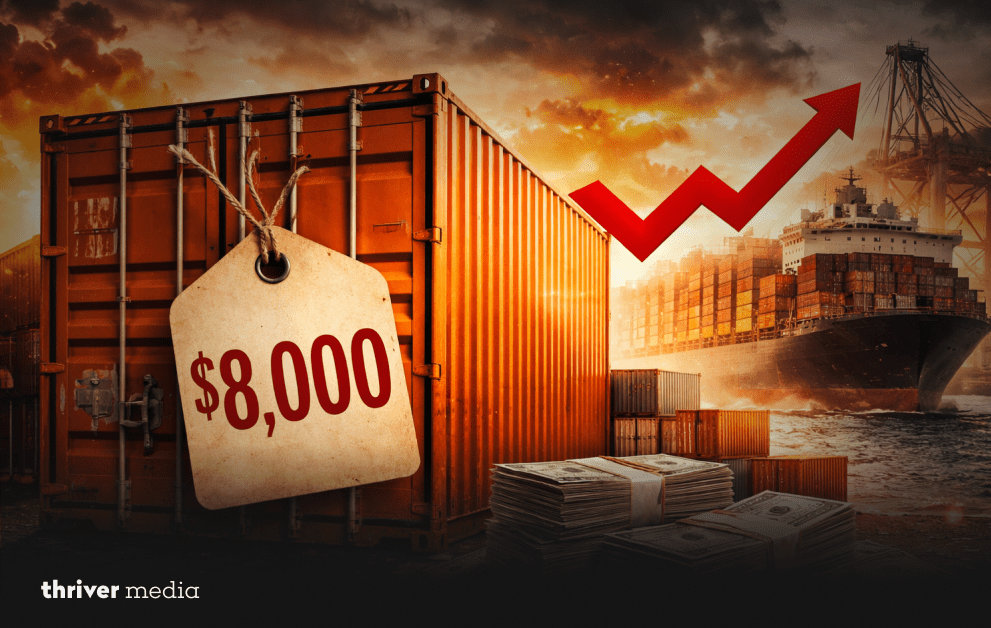
Why a 20-Foot Box Now Costs an Arm and a Leg
Remember 2021, when shipping containers became a global meme because they cost so much? We’re back.
The war has turned the Middle East’s shipping lanes into a no-go zone. The Strait of Hormuz is effectively closed. The Red Sea is increasingly dangerous. Shipping companies are responding in two ways: charging massive “emergency conflict surcharges” or simply refusing to take cargo to the region at all.
Here’s what the numbers look like:
- Emergency conflict surcharges: $1,000 to $3,000 per container
- Red Sea freight: Up from $3,000 per container to $10,000
- 20-foot containers to the Middle East: Base rates jumped from $2,300 to $3,300, with war surcharges on top
MSC, one of the world’s largest shipping lines, has simply stopped accepting bookings to the Middle East altogether, citing crew safety concerns . Other carriers like CMA CGM and SeaLead are slapping surcharges on everything moving through the region.
The impact? If you’re buying anything imported electronics, clothing, furniture, appliances that container fee gets passed straight to you.
The Price Surges at a Glance
Here’s a snapshot of how the Iran war has hit American wallets in just four weeks:
FAQs
When will gas prices come back down?
Not quickly. Even if the war ends tomorrow, economists say it would take six to eight weeks for oil production and shipments to normalize. And prices likely won’t return to pre-war levels expect oil to settle around $80/barrel, higher than before the conflict.
Will this cause a recession?
It’s a real risk. Oxford Economics has already downgraded its 2026 growth forecast from 2.8% to 2.4% due to the war. If the conflict drags on and oil stays above $100, recession fears will intensify.
How long will this last?
That’s the billion-dollar question literally. The timeline depends entirely on when the fighting stops and how quickly the Strait of Hormuz reopens. But even under the best-case scenario, analysts say we’re looking at weeks of elevated prices before any real relief arrives.
Bottom Line
The Iran war has done what wars always do: make everything more expensive. Gas, diesel, jet fuel, groceries, shipping, and the very confidence that keeps the economy humming all of it has taken a hit in just four weeks. The administration promised a quick conflict with rapidly falling prices, but the experts are telling a different story: one of slow recovery, lingering inflation, and a political landscape that’s shifting by the day.
Conclusion: The War at Home
There’s an old saying in the energy industry: “Prices rise like a rocket, fall like a feather”. We’ve watched the rocket launch over the past month. Now we’re all waiting to see how long it takes for the feather to drift back down.
The war in Iran is happening thousands of miles away, but its impact is being felt at every American gas station, grocery store, and airport. The Strait of Hormuz may seem like a distant waterway, but when it chokes, the whole world feels it. And right now, the whole world is choking.
The coming weeks will tell us whether this conflict winds down quickly or drags into months. But one thing is already clear: the economic pain of this war has only just begun to reach American households. And relief, when it comes, will be gradual.
Official Source Links:
Disclaimer: The news and information presented on our platform, Thriver Media, are curated from verified and authentic sources, including major news agencies and official channels.
Want more? Subscribe to Thriver Media and never miss a beat.